
I. IN BRIEF
I.1 How to use this document
This document is intended as a quick reference tool.
- Use Ctrl + F (or Cmd + F on macOS),
- or the website search function, to find specific terms.
I.2 Sources and legal notice
The definitions provided are based on the regulations and official documents listed in the annex.
While every effort is made to keep this content accurate and up to date, only the versions published in the Official Journal of the European Union are legally binding.
This document is provided for information purposes only and has no legal effect.
Icarus Toolbox assumes no liability for the use or interpretation of its contents.
The authentic regulatory texts are available through EUR-Lex and the EASA website.
II. Aircrafts
II.1 General Aircraft Definitions
Aircraft = any machine that can derive support in the atmosphere from the reactions of the air other than the reactions of the air against the earth's surface.
Unidentified aircraft = an aircraft which has been observed or reported to be operating in a given area but whose identity has not been established.
II.2 General Aircraft Definitions
Manned VCA = a VCA piloted by at least one pilot on board.
Unmanned aircraft = any aircraft operating or designed to operate autonomously or to be piloted remotely without a pilot on board.
Unmanned free balloon = a non-power-driven, unmanned, lighter-than-air aircraft in free flight.
II.3 Lighter-Than-Air Aircraft
Balloon = a manned lighter-than-air aircraft which is not power-driven and sustains flight through the use of either a lighter-than-air gas or an airborne heater, including gas balloons, hot-air balloons, mixed balloons and, although power-driven, hot-air airships.
Tethered gas balloon = a gas balloon with a tether system that continuously anchors the balloon to a fixed point during operation.
II.4 Heavier-Than-Air Aircraft – Fixed Wing
Aeroplane = an engine-driven fixed-wing aircraft heavier than air that is supported in flight by the dynamic reaction of the air against its wings.
Landplane = a fixed wing aircraft which is designed for taking off and landing on land and includes amphibians operated as landplanes.
Seaplane = a fixed wing aircraft which is designed for taking off and landing on water and includes amphibians operated as seaplanes.
Sailplane = a heavier-than-air aircraft which is supported in flight by the dynamic reaction of the air against its fixed lifting surfaces, the free flight of which does not depend on an engine, including also hang gliders, paragliders and other comparable craft.
II.5 Rotorcraft
Helicopter = a type of rotorcraft supported in flight chiefly by the reactions of the air on up to two power-driven rotors on substantially vertical axes.
Rotorcraft = a power-driven, heavier-than-air aircraft that depends principally for its support in flight on the lift generated by up to two rotors.
II.6 VTOL And VCA Aircraft
Vertical take-off and landing (VTOL)-capable aircraft (VCA) = a power-driven, heavier-than-air aircraft other than aeroplane or rotorcraft, capable of performing vertical take-off and landing by means of lift and thrust units used to provide lift during the take-off and landing.
Vertical take-off and landing (VTOL)-capable aircraft (VCA) = a power-driven, heavier-than-air aircraft, other than aeroplane or rotorcraft, capable of performing vertical take-off and landing by means of lift and thrust units used to provide lift during take-off and landing.
II.7 European Light Aircraft (ELA)
ELA1 aircraft = the following manned European Light Aircraft:
(a) an aeroplane with a Maximum Take-off Mass (MTOM) of 1 200 kg or less that is not classified as complex motor-powered aircraft.
(b) a sailplane or powered sailplane of 1 200 kg MTOM or less.
(c) a balloon with a maximum design lifting gas or hot air volume of not more than 3 400 m3 for hot air balloons, 1 050 m3 for gas balloons, 300 m3 for tethered gas balloons.
ELA2 aircraft = the following manned European Light Aircraft:
(a) an aeroplane with a Maximum Take-off Mass (MTOM) of 2 000 kg or less that is not classified as complex motor-powered aircraft.
(b) a sailplane or powered sailplane of 2 000 kg MTOM or less.
(c) a balloon.
(d) a Very Light Rotorcraft with a MTOM not exceeding 600 kg which is of a simple design, designed to carry not more than two occupants, not powered by turbine and/or rocket engines. restricted to VFR day operations.
II.8 Complex And Certified Aircraft Categories
Complex motor-powered aircraft’ shall mean:
(a) an aeroplane:
— with a maximum certificated take-off mass exceeding 5 700 kg, or
— certificated for a maximum passenger seating configuration of more than nineteen, or
— certificated for operation with a minimum crew of at least two pilots, or
— equipped with (a) turbojet engine(s) or more than one turboprop engine, or
(b) a helicopter certificated:
(i) for a maximum take-off mass exceeding 3 175 kg, or
(ii) for a maximum passenger seating configuration of more than nine, or
(iii) for operation with a minimum crew of at least two pilots, or
(c) a tilt rotor aircraft.
II.9 Aircraft Performance And Certification Concepts (VCA)
Category Enhanced = a category for VCA certification and operation according to which the aircraft meets the requirements for continued safe flight and landing following a critical failure for performance (CFP).
Certified minimum performance (CMP) = in relation to VCA, the set of performance data obtained by considering the effect of single failures and combinations of failures that are not extremely improbable on nominal performance parameters.
Continued safe flight and landing (CSFL) = in relation to a VCA operated in the category Enhanced, that the aircraft is capable of continued controlled flight and landing at a vertiport, possibly using emergency procedures, without requiring exceptional piloting skills or strength.
Critical failure for performance (CFP) = in relation to VCA, a failure or a combination of failures that results in the maximum degradation for a given flight phase and performance parameter. the set of critical failures for performance is used to establish the certified minimum performance (CMP).
Limited overwater operation = an IAM operation with a VCA that is conducted for a limited flight time over water.
II.10 Passenger Configuration And Operations
Maximum operational passenger seating configuration (MOPSC) = the maximum passenger seating capacity of an individual aircraft, excluding crew seats, established for operational purposes and specified in the operations manual. Taking as a baseline the maximum passenger seating configuration established during the certification process conducted for the type certificate (TC), supplemental type certificate (STC) or change to the TC or STC as relevant to the individual aircraft, the MOPSC may establish an equal or lower number of seats, depending on the operational constraints.
II.11 Model And Toy Aircraft
Model aircraft = an unmanned aircraft, other than toy aircraft, having an operating mass not exceeding limits prescribed by the competent authority, that is capable of sustained flight in the atmosphere and that is used exclusively for display or recreational activities.
Toy aircraft = an unmanned aircraft designed or intended for use, whether or not exclusively, in play by children under 14 years of age.
II.12 Aeroplanes – Performance Classes
Performance class A aeroplanes = multi-engined aeroplanes powered by turbo-propeller engines with an MOPSC of more than nine or a maximum take-off mass exceeding 5 700 kg, and all multi-engined turbo-jet powered aeroplanes.
Performance class B aeroplanes = aeroplanes powered by propeller engines with an MOPSC of nine or less and a maximum take-off mass of 5 700 kg or less.
Performance class C aeroplanes = aeroplanes powered by reciprocating engines with an MOPSC of more than nine or a maximum take-off mass exceeding 5 700 kg.
II.13 Helicopters – Categories And Performance Classes
Category A with respect to helicopters = a multi-engined helicopter designed with engine and system isolation features specified in the applicable certification specification and capable of operations using take-off and landing data scheduled under a critical engine failure concept that assures adequate designated surface area and adequate performance capability for continued safe flight or safe rejected take-off in the event of engine failure.
Category B with respect to helicopters = a single-engined or multi-engined helicopter that does not meet category A standards. Category B helicopters have no guaranteed capability to continue safe flight in the event of an engine failure, and unscheduled landing is assumed.
Operation in performance class 1 = an operation that, in the event of failure of the critical engine, the helicopter is able to land within the rejected take-off distance available or safely continue the flight to an appropriate landing area, depending on when the failure occurs.
Operation in performance class 2 = an operation that, in the event of failure of the critical engine, performance is available to enable the helicopter to safely continue the flight, except when the failure occurs early during the take-off manoeuvre or late in the landing manoeuvre, in which cases a forced landing may be required.
Operation in performance class 3 = an operation that, in the event of an engine failure at any time during the flight, a forced landing may be required in a multi-engined helicopter and will be required in a single-engined helicopter.
III. Aerodrome, airport, runway
III.1 Aerodrome - General definitions
Aerodrome = a defined area, on land or on water, on a fixed, fixed offshore or floating structure, including any buildings, installations and equipment thereon, intended to be used either wholly or in part for the arrival, departure and surface movement of aircraft.
Heliport = an aerodrome or a defined area on a structure intended to be used wholly or in part for the arrival, departure and surface movement of helicopters.
III.2 AERODROME AREAS AND SURFACES
Apron = a defined area of an aerodrome intended to accommodate aircraft for purposes of loading or unloading passengers, baggage, mail or cargo, fuelling, parking or maintenance.
Landing area = that part of a movement area intended for the landing or take-off of aircraft.
Manoeuvring area = that part of an aerodrome to be used for the take-off, landing and taxiing of aircraft, excluding aprons.
Movement area = that part of an aerodrome to be used for the take-off, landing and taxiing of aircraft, consisting of the manoeuvring area and the apron(s).
Signal area = an area on an aerodrome used for the display of ground signals.
III.3 RUNWAYS AND RUNWAY COMPONENTS
Runway = a defined rectangular area on a land aerodrome prepared for the landing and take-off of aircraft.
Runway-holding position = a designated position intended to protect a runway, an obstacle limitation surface, or an instrument landing system (ILS)/microwave landing system (MLS) critical or sensitive area at which taxiing aircraft and vehicles are to stop and hold, unless otherwise authorised by the aerodrome control tower.
Separate runways = runways at the same aerodrome that are separate landing surfaces, such that if one runway is blocked, it does not prevent the planned type of operations on the other runway.
Threshold = the beginning of that portion of the runway usable for landing.
Touchdown zone = the portion of a runway, beyond the threshold, where it is intended that landing aeroplanes first contact the runway.
III.4 Runway Surface Conditions and Contaminants
Contaminated runway = a runway of which a significant portion of its surface area, within the length and width being used, is covered by one or more runway surface contaminants.
Dry runway = a runway whose surface is free of visible moisture and not contaminated within the area intended to be used.
Specially prepared winter runway = a runway with a dry frozen surface of compacted snow or ice which has been treated with sand or grit or mechanically treated to improve runway friction.
Compacted snow = Snow that has been compacted into a solid mass such that aeroplane tyres, at operating pressures and loadings, run on the runway surface without significant further compaction or rutting.
Dry snow = Snow from which a snowball cannot readily be made.
Frost = Ice crystals formed from airborne moisture on a surface whose temperature is below freezing*. Frost differs from ice in that frost crystals grow independently and have a granular texture.
*‘below freezing’ refers to air temperature equal to or lower than the freezing point of water (0 C/32°F).
Ice = Water that has frozen or compacted snow that has transitioned into ice under cold and dry conditions, excluding wet ice with a surface film of water.
Slippery wet runway = A wet runway where the surface friction characteristics on a significant portion of the runway have been determined to be degraded.
Slush = Snow that is so water-saturated that water drains from it when a handful is picked up or splatters when stepped on forcefully.
Standing water = Water on a runway surface with a depth greater than 3 mm.
Wet snow = Snow containing enough water to form a compacted snowball without squeezing out water.
Specially prepared winter runway = A runway with a dry frozen surface of compacted snow and/or ice treated mechanically, chemically, or with sand or grit to improve friction, which is monitored and reported in accordance with national procedures.
Runway condition code (RWYCC) = A numerical code used in runway condition reports to describe the effect of runway surface conditions on aeroplane deceleration performance and lateral control.
Runway condition report (RCR) = a comprehensive standardised report relating to the conditions of the runway surface and their effect on aeroplane landing and take-off performance, described by means of runway condition codes.
Specific gravity = The density of the contaminant divided by the density of water.
III.5 TAXIWAYS AND GROUND MOVEMENT
Taxiway = a defined path on a land aerodrome established for the taxiing of aircraft and intended to provide a link between one part of the aerodrome and another.
Apron taxiway = a portion of a taxiway system located on an apron and intended to provide a through taxi route across the apron.
Rapid exit taxiway = a taxiway connected to a runway at an acute angle designed to allow landing aeroplanes to turn off at higher speeds, minimising runway occupancy time.
Ground movement = the movement of an aircraft on the movement area of an aerodrome or a vertiport with the aid of external equipment not powered by the aircraft.
III.6 AERODROME TRAFFIC AND PROTECTION
Aerodrome traffic = all traffic on the manoeuvring area of an aerodrome and all aircraft flying in the vicinity of an aerodrome.
Aerodrome traffic circuit = the specified path to be flown by aircraft operating in the vicinity of an aerodrome.
Aerodrome traffic zone = an airspace of defined dimensions established around an aerodrome for the protection of aerodrome traffic.
Air traffic = all aircraft in flight or operating on the manoeuvring area of an aerodrome.
Essential local traffic = any aircraft, vehicle or personnel that may constitute a hazard to the aircraft concerned.
Essential traffic = controlled traffic to which separation is applicable but which, in relation to a particular controlled flight, is not separated by the appropriate separation minima.
III.7 AERODROME EQUIPMENT AND PROTECTION AREAS
Critical area = an area of defined dimensions around precision approach ground equipment within which the presence of aircraft or vehicles causes unacceptable disturbance of guidance signals.
Sensitive area = an area extending beyond the critical area where the presence or movement of aircraft or vehicles may degrade guidance signals.
Safety-related aerodrome equipment = any equipment used or intended to contribute to the safe operation of aircraft at an aerodrome.
III.8 ALTERNATES AND OPERATIONAL AERODROMES
Adequate aerodrome = an aerodrome on which the aircraft can be operated taking account of performance requirements and runway characteristics.
Weather-permissible aerodrome = an adequate aerodrome where meteorological conditions are at or above operating minima and runway conditions allow a safe landing.
Alternate aerodrome = an adequate aerodrome to which an aircraft may proceed when it becomes impossible or inadvisable to land at the aerodrome of intended landing.
Take-off alternate aerodrome = an alternate aerodrome usable shortly after take-off if the aerodrome of departure cannot be used.
En-route alternate aerodrome = an alternate aerodrome at which an aircraft may land if a diversion becomes necessary en route.
Fuel/energy en-route alternate aerodrome = an en-route alternate aerodrome required at planning stage for fuel or energy calculation.
Destination alternate aerodrome = an alternate aerodrome at which an aircraft may land if landing at the destination becomes impossible or inadvisable.
III.9 HELICOPTER, VCA, VERTIPORT AND VEMS SITESALTERNATES
Final approach and take-off area (FATO) = a defined area for helicopter or VCA operations over which the final approach manoeuvre is completed and from which take-off is commenced.
Elevated final approach and take-off area (elevated FATO) = a FATO at least 3 m above the surrounding surface.
Helideck = a FATO located on a floating or fixed offshore structure.
Operating site = a site, other than an aerodrome, selected for landing, take-off, hoist or external load operations.
HEMS operating base = an aerodrome at which the HEMS crew and helicopter are on standby.
HEMS operating site = a site selected by the commander during a HEMS flight.
HHO site = a specified area at which a helicopter performs a hoist transfer.
Offshore location = a facility intended for helicopter operations on a fixed or floating offshore structure or vessel.
Public interest site (PIS) = a site used exclusively for operations in the public interest.
Vertiport = an area used or intended for the landing, take-off and movement of VCA.
Adequate vertiport = a vertiport suitable for the intended VCA operation and available at the expected time of use.
VEMS operating base = a vertiport where the VCA and VEMS crew are on standby.
VEMS operating site = a site selected by the pilot-in-command for VEMS operations
IV. Airspaces, zones, aeras, environment and performance context
IV.1 ENVIRONMENT AND TERRAIN
Hostile environment = an area where a safe forced landing cannot be accomplished, occupants cannot be adequately protected, SAR response is inadequate, or there is unacceptable risk to persons or property.
Non-hostile environment = an environment where a safe forced landing can be accomplished, occupants are protected and SAR response is adequate.
Congested area = in relation to a city, town or settlement, any area substantially used for residential, commercial or recreational purposes.
Mountainous area = an area where terrain elevation changes exceed 900 m within 18.5 km.
Open sea area = the area of water to seaward of the coastline.
Terrain = the surface of the Earth containing naturally occurring features, excluding obstacles.
IV.2 OBSTACLES
Obstacle = any fixed or mobile object that is located on areas intended for aircraft movement, extends above protected surfaces, or is assessed as a hazard to air navigation.
IV.3 DECLARED DISTANCES AND PERFORMANCE AREAS
Take-off run available (TORA) = the length of runway declared available for the ground run of an aeroplane taking off.
Take-off distance available (TODA) = TORA plus the length of the clearway, if provided.
Accelerate-stop distance available (ASDA) = TORA plus the length of stopway, if declared available.
Landing distance available (LDA) = the length of runway declared available and suitable for landing.
Clearway = a defined area beyond the runway under the control of the appropriate authority over which an aircraft may make part of its initial climb.
Defined point after take-off (DPATO) = the point before which continued safe flight with the critical engine inoperative is not assured.
Defined point before landing (DPBL) = the point after which continued safe flight with the critical engine inoperative is not assured.
Landing decision point (LDP) = the point from which a landing may be safely continued or a balked landing initiated.
Rejected take-off distance available (RTODA) = the distance declared available to complete a rejected take-off.
Rejected take-off distance required (RTODR) = the distance required to stop following engine failure at the take-off decision point.
Take-off decision point (TDP) = the point from which a rejected or continued take-off is assured following engine failure.
Take-off flight path = the vertical and horizontal path followed after take-off with the critical engine inoperative.
IV.4 AIRSPACES, ZONES AND JURISDICTION
Danger area = an airspace within which activities dangerous to aircraft may exist at specified times.
Prohibited area = an airspace within which flight is prohibited.
Restricted area = an airspace within which flight is restricted under specified conditions.
Advisory airspace = an airspace of defined dimensions or designated route within which air traffic advisory service is available.
Radio mandatory zone (RMZ) = an airspace in which carriage and operation of radio equipment is mandatory.
Transponder mandatory zone (TMZ) = an airspace in which carriage and operation of pressure-altitude reporting transponders is mandatory.
High seas airspace = airspace beyond land territory and territorial seas.
Territory = land areas and territorial waters under the sovereignty or jurisdiction of a State.
U-space airspace = a UAS geographical zone where unmanned aircraft operations are only allowed with U-space services.
V. AIR TRAFFIC SERVICE
V.1 General ATS Concepts
Air traffic service (ATS) = a generic term meaning variously, flight information service, alerting service, air traffic advisory service, air traffic control service (area control service, approach control service or aerodrome control service).
Air traffic services (ATS) unit = a generic term meaning, variously, air traffic control unit, flight information centre, aerodrome flight information service unit or air traffic services reporting office.
ATS route = a specified route designed for channelling the flow of traffic as necessary for the provision of air traffic services.
ATS route = a specified route designed for channelling the flow of traffic as necessary for the provision of ATS.
V.2 CLASSIFICATION OF AIRSPACES
Class A = an airspace in which only IFR flights are permitted. All flights are provided with air traffic control service and are separated from each other. Continuous air-ground voice communications are required for all flights, and all flights are subject to ATC clearance.
Class B = an airspace in which IFR and VFR flights are permitted. All flights are provided with air traffic control service and are separated from each other. Continuous air-ground voice communications are required for all flights, and all flights are subject to ATC clearance.
Class C = an airspace in which IFR and VFR flights are permitted. All flights are provided with air traffic control service. IFR flights are separated from other IFR flights and from VFR flights. VFR flights are separated from IFR flights and receive traffic information in respect of other VFR flights and traffic avoidance advice on request. Continuous air-ground voice communications are required for all flights. For VFR flights, a speed limitation of 250 kts IAS applies below 3 050 m (10 000 ft) AMSL, except where approved by the competent authority for aircraft types that cannot maintain this speed for technical or safety reasons. All flights are subject to ATC clearance.
Class D = an airspace in which IFR and VFR flights are permitted. All flights are provided with air traffic control service. IFR flights are separated from other IFR flights and receive traffic information in respect of VFR flights and traffic avoidance advice on request. VFR flights receive traffic information in respect of all other flights and traffic avoidance advice on request. Continuous air-ground voice communications are required for all flights. A speed limitation of 250 kts IAS applies to all flights below 3 050 m (10 000 ft) AMSL, except where approved by the competent authority for aircraft types that cannot maintain this speed for technical or safety reasons. All flights are subject to ATC clearance.
Class E = an airspace in which IFR and VFR flights are permitted. IFR flights are provided with air traffic control service and are separated from other IFR flights. All flights receive traffic information as far as is practical. Continuous air-ground voice communications are required for IFR flights. A speed limitation of 250 kts IAS applies to all flights below 3 050 m (10 000 ft) AMSL, except where approved by the competent authority for aircraft types that cannot maintain this speed for technical or safety reasons. All IFR flights are subject to ATC clearance. Class E airspace shall not be used for control zones.
Class F = an airspace in which IFR and VFR flights are permitted. All participating IFR flights receive an air traffic advisory service. All flights receive flight information service if requested. Continuous air-ground voice communications are required for IFR flights participating in the advisory service, and all IFR flights shall be capable of establishing air-ground voice communications. A speed limitation of 250 kts IAS applies to all flights below 3 050 m (10 000 ft) AMSL, except where approved by the competent authority for aircraft types that cannot maintain this speed for technical or safety reasons. ATC clearance is not required.
Class G = an airspace in which IFR and VFR flights are permitted. Flights receive flight information service if requested. All IFR flights shall be capable of establishing air-ground voice communications. A speed limitation of 250 kts IAS applies to all flights below 3 050 m (10 000 ft) AMSL, except where approved by the competent authority for aircraft types that cannot maintain this speed for technical or safety reasons. ATC clearance is not required.
V.3 ATS Units And Offices
Air traffic services (ATS) reporting office (ARO) = a unit established for the purpose of receiving reports concerning air traffic services and flight plans submitted before departure.
Air traffic control unit = a generic term meaning variously, area control centre, approach control unit or aerodrome control tower.
Air traffic control (ATC) unit or ATC unit is a generic term meaning variously, area control centre, approach control unit or aerodrome control tower.
Aerodrome control tower = a unit established to provide air traffic control service to aerodrome traffic.
Aerodrome control tower = a unit established to provide air traffic control service to aerodrome traffic.
Approach control unit = a unit established to provide air traffic control service to controlled flights arriving at, or departing from, one or more aerodromes.
Approach control unit = a unit established to provide air traffic control service to controlled flights arriving at, or departing from, one or more aerodromes.
Area control centre (ACC) = a unit established to provide air traffic control service to controlled flights in control areas under its jurisdiction.
Flight information centre = a unit established to provide flight information service and alerting service.
Flight information centre (FIC) = a unit established to provide flight information service and alerting service.
Receiving unit = the air traffic control unit that receives data.
Transferring unit = air traffic control unit in the process of transferring the responsibility for providing air traffic control service to an aircraft to the next air traffic control unit or air traffic controller along the route of flight.
V.4 Air Traffic Control Services
Aerodrome control service = air traffic control service for aerodrome traffic.
Area control service = air traffic control service for controlled flights in control areas.
Air traffic control service = a service provided for the purpose of:
(a) preventing collisions:
(1) between aircraft. and
(2) on the manoeuvring area between aircraft and obstructions. and
(b) expediting and maintaining an orderly flow of air traffic.
Air traffic advisory service = a service provided within advisory airspace to ensure separation, in so far as practical, between aircraft which are operating on instrument flight rules (IFR) flight plans.
Air traffic advisory service = a service provided within an airspace of defined dimensions, or a designated route (advisory airspace) to ensure separation, in so far as practical, between aircraft which are operating on instrument flight rules (IFR) flight plans.
Advisory airspace = an airspace of defined dimensions, or designated route, within which air traffic advisory service is available.
Flight information service = a service provided for the purpose of giving advice and information useful for the safe and efficient conduct of flights.
Flight information service = a service provided for the purpose of giving advice and information useful for the safe and efficient conduct of flights.
Alerting service = a service provided to notify appropriate organisations regarding aircraft in need of search and rescue aid, and assist such organisations as required.
Alerting service = a service provided to notify appropriate organisations regarding aircraft in need of search and rescue aid, and assist such organisations as required.
V.5 Clearances And Instructions
Air traffic control (ATC) clearance = authorisation for an aircraft to proceed under conditions specified by an air traffic control unit.
Air traffic control clearance or ATC clearance = authorisation for an aircraft to proceed under conditions specified by an air traffic control unit.
Air traffic control instruction = directives issued by air traffic control for the purpose of requiring a pilot to take a specific action.
Air traffic control instruction or ATC instruction = directives issued by ATC for the purpose of requiring a pilot to take a specific action.
Clearance limit = the point to which an aircraft is granted an air traffic control clearance.
Downstream clearance = a clearance issued to an aircraft by an air traffic control unit that is not the current controlling authority of that aircraft.
Downstream clearance = a clearance issued to an aircraft by an air traffic control unit that is not the current controlling authority of that aircraft.
V.6 Controlled Flights And Airspace
Controlled aerodrome = an aerodrome at which air traffic control service is provided to aerodrome traffic.
Controlled airspace = an airspace of defined dimensions within which air traffic control service is provided in accordance with the airspace classification.
Controlled flight = any flight which is subject to an air traffic control clearance.
Control area = a controlled airspace extending upwards from a specified limit above the earth.
Control zone = a controlled airspace extending upwards from the surface of the earth to a specified upper limit.
Terminal control area (TMA) = a control area normally established at the confluence of ATS routes in the vicinity of one or more major aerodromes.
Airway = a control area or portion thereof established in the form of a corridor.
Area navigation route = an ATS route established for the use of aircraft capable of employing area navigation.
V.7 Surveillance And Navigation Support
Air traffic services (ATS) surveillance service = a service provided directly by means of an ATS surveillance system.
ATS surveillance system = a generic term meaning variously, ADS-B, PSR, SSR or any comparable ground-based system that enables the identification of aircraft.
Vectoring = the provision of navigational guidance to aircraft in the form of specific headings, based on the use of an ATS surveillance system.
V.8 Traffic Information And Collision Avoidance
Traffic information = information issued by an air traffic services unit to alert a pilot to other known or observed air traffic which may be in proximity to the position or intended route of flight and to help the pilot avoid a collision.
Traffic avoidance advice = an advice provided by an air traffic services unit specifying manoeuvres to assist a pilot to avoid a collision.
V.9 Flight Planning And Time Definitions
Filed flight plan (FPL) = the flight plan as filed with an ATS unit by the pilot or a designated representative, without any subsequent changes.
Flight plan = specified information provided to air traffic services units, relative to an intended flight or portion of a flight of an aircraft.
Estimated elapsed time = the estimated time required to proceed from one significant point to another.
Total estimated elapsed time =:
(a) for IFR flights, the estimated time required from take-off to arrive over that designated point, defined by reference to navigation aids, from which it is intended that an instrument approach procedure will be commenced, or, if no navigation aid is associated with the destination aerodrome, to arrive over the destination aerodrome.
(b) for VFR flights, the estimated time required from take-off to arrive over the destination aerodrome.
Estimated off-block date = the estimated date on which the aircraft will commence movement associated with departure.
Estimated off-block time = the estimated time at which the aircraft will commence movement associated with departure.
Estimated time of arrival =:
(a) for IFR flights, the time at which it is estimated that the aircraft will arrive over a designated point, defined by reference to navigation aids, from which it is intended that an instrument approach procedure will be commenced, or, if no navigation aid is associated with the aerodrome, the time at which the aircraft will arrive over the aerodrome.
(b) for visual flight rules (VFR) flights, the time at which it is estimated that the aircraft will arrive over the aerodrome.
Estimated time of arrival (ETA) = for IFR flights, the time at which it is estimated that the aircraft will arrive over that designated point, defined by reference to navigation aids, from which it is intended that an instrument approach procedure will be commenced, or, if no navigation aid is associated with the aerodrome, the time at which the aircraft will arrive over the aerodrome. For visual flight rules (VFR) flights, the time at which it is estimated that the aircraft will arrive over the aerodrome.
Expected approach time = the time at which ATC expects that an arriving aircraft, following a delay, will leave the holding fix to complete its approach for a landing. The actual time of leaving the holding fix will depend upon the approach clearance.
V.10 Aerodrome Information Services
Aerodrome flight information service (AFIS) = flight information service for aerodrome traffic provided by a designated air traffic services provider.
AFIS aerodrome = an aerodrome where AFIS is provided within the airspace associated with such aerodrome.
AFIS unit = a unit established to provide AFIS and alerting service.
Flight information zone = an airspace of defined dimension within which aerodrome flight information service and alerting service for aerodrome traffic are provided.
Aerodrome meteorological office = an office responsible for providing meteorological service for an aerodrome.
V.12 Information Broadcast Services
Automatic terminal information service (ATIS) = the automatic provision of current, routine information to arriving and departing aircraft throughout 24 hours a day or a specified portion thereof.
Data link-automatic terminal information service (D-ATIS) = the provision of ATIS via data link.
Voice-automatic terminal information service (Voice-ATIS) = the provision of ATIS by means of continuous and repetitive voice broadcasts.
Broadcast = a transmission of information relating to air navigation that is not addressed to a specific station or stations.
V.13 Search And Rescue Phases And Units
Rescue coordination centre (RCC) = a unit responsible for promoting efficient organisation of search and rescue services, and for coordinating the conduct of search and rescue operations within a search and rescue region.
Search and rescue services unit is a generic term covering, as the case may be, rescue coordination centre, rescue sub-centre or alerting post.
INCERFA is the code word used to designate an uncertainty phase.
Uncertainty phase = a situation wherein uncertainty exists as to the safety of an aircraft and its occupants.
ALERFA is the code word used to designate an alert phase.
Alert phase = a situation wherein apprehension exists as to the safety of an aircraft and its occupants.
DETRESFA is the code word used to designate a distress phase.
Distress phase = a situation wherein there is reasonable certainty that an aircraft and its occupants are threatened by grave and imminent danger or require immediate assistance.
V.14 ATM, ANS And U-Space
ATM/ANS = air traffic management as defined in point (9) of Article 2 of Regulation (EU) 2024/2803 and air navigation services as defined in point (5) of Article 2 of that Regulation, as well as the network functions referred to in Article 37 of that Regulation and services consisting in the origination and processing of data and in the formatting and delivering of data to general air traffic for the purpose of air navigation.
ATM/ANS constituent = tangible objects such as hardware and intangible objects such as software upon which the interoperability of the EATMN depends.
ATM/ANS system = the aggregation of airborne and ground-based constituents, as well as space-based equipment, that provides support for air navigation services for all phases of flight.
ATM Master Plan = the plan endorsed by Council Decision 2009/320/EC ( 2 ), in accordance with Article 1(2) of Council Regulation (EC) No 219/2007 ( 3 ).
U-space airspace = a UAS geographical zone designated by Member States, where UAS operations are only allowed to take place with the support of U-space services.
U-space service = a service relying on digital services and automation of functions designed to support safe, secure and efficient access to U-space airspace for a large number of UAS.
Single European Sky airspace = airspace above the territory to which the Treaties apply, as well as any other airspace where Member States apply Regulation (EU) 2024/2803 in accordance with Article 1(4) of that Regulation.
National competent authority = one or more entities designated by a Member State and having the necessary powers and allocated responsibilities for performing the tasks related to certification, oversight and enforcement in accordance with this Regulation and with the delegated and implementing acts adopted on the basis thereof.
VI. Procedures, Operations and Flights
VI.1 Types Of Operations – General
Aerial work = an aircraft operation in which an aircraft is used for specialised services such as agriculture, construction, photography, surveying, observation and patrol, search and rescue, aerial advertisement, etc.
Aerial work = an aircraft operation in which an aircraft is used for specialised services such as agriculture, construction, photography, surveying, observation and patrol, search and rescue or aerial advertisement.
Commercial air transport = any aircraft operation involving the transport of passengers, cargo or mail for remuneration or other valuable consideration.
Commercial air transport = an aircraft operation to transport passengers, cargo or mail for remuneration or other valuable consideration.
Commercial operation = any operation of an aircraft, in return for remuneration or other valuable consideration, which is available for the public or, when not made available to the public, which is performed under a contract between an operator and a customer, where the latter has no control over the operator.
General aviation = any civil aircraft operation other than aerial work or commercial air transport.
Specialised operation = any operation, other than commercial air transport operation, where the aircraft is used for specialised activities such as agriculture, construction, photography, surveying, observation and patrol, aerial advertisement, maintenance check flights.
High risk commercial specialised operation = any commercial specialised aircraft operation carried out over an area where the safety of third parties on the ground is likely to be endangered in the event of an emergency, or, as determined by the competent authority of the place where the operation is conducted, any commercial specialised aircraft operation that, due to its specific nature and the local environment in which it is conducted, poses a high risk, in particular to third parties on the ground.
VI.2 Commercial and contractual arrangements
Air taxi operation = for the purpose of flight time and duty time limitations, a non-scheduled on demand commercial air transport operation with an aeroplane with a maximum operational passenger seating configuration (MOPSC) of 19 or less.
Code share = an arrangement under which an operator places its designator code on a flight operated by another operator, and sells and issues tickets for that flight.
Dry lease agreement = an agreement between undertakings pursuant to which the aircraft is operated under the air operator certificate (AOC) of the lessee or, in the case of commercial operations other than CAT, under the responsibility of the lessee.
Wet lease agreement = an agreement:
— in the case of CAT operations, between air carriers pursuant to which the aircraft is operated under the AOC of the lessor. or
— in the case of commercial operations other than CAT, between operators pursuant to which the aircraft is operated under the responsibility of the lessor.
VI.3 Special Flights and activities
Aerobatic flight = manoeuvres intentionally performed by an aircraft involving an abrupt change in its attitude, an abnormal attitude, or an abnormal variation in speed, not necessary for normal flight or for instruction for licenses or ratings other than aerobatic rating.
Competition flight = any flying activity where the aircraft is used in air races or contests, as well as where the aircraft is used to practice for air races or contests and to fly to and from racing or contest events.
Flying display = any flying activity deliberately performed for the purpose of providing an exhibition or entertainment at an advertised event open to the public, including where the aircraft is used to practice for a flying display and to fly to and from the advertised event.
Introductory flight = any operation against remuneration or other valuable consideration consisting of an air tour of short duration for the purpose of attracting new trainees or new members, performed either by a training organisation referred to in Article 10a of Commission Regulation (EU) No 1178/2011 ( 1 ) or by an organisation created with the aim of promoting aerial sport or leisure aviation.
Maintenance check flight (“MCF”) = a flight of an aircraft with an airworthiness certificate or with a permit to fly which is carried out for troubleshooting purposes or to check the functioning of one or more systems, parts or appliances after maintenance, if the functioning of the systems, parts or appliances cannot be established during ground checks and which is carried out in any of the following situations:
(a) as required by the aircraft maintenance manual (AMM’) or any other maintenance data issued by a design approval holder being responsible for the continuing airworthiness of the aircraft.
(b) after maintenance, as required by the operator or proposed by the organisation responsible for the continuing airworthiness of the aircraft.
(c) as requested by the maintenance organisation for verification of a successful defect rectification.
(d) to assist with fault isolation or troubleshooting.
VI.4 Emergency, Medical And Rescue Operations
HEMS flight = a flight by a helicopter operating under a HEMS approval, where immediate and rapid transportation is essential and the purpose of which is either of the following:
(a) to facilitate emergency medical assistance by carrying one or more of the following:
(i) medical personnel.
(ii) medical supplies (equipment, blood, organs, drugs).
(iii) ill or injured persons and other persons directly involved.
(b) to perform an operation where a person faces an imminent or anticipated health risk posed by the environment and either of the following conditions is met:
(i) that person needs to be rescued or provided with supplies.
(ii) persons, animals or equipment need to be transported to and from the HEMS operating site.
HEMS HEC operation = air and ground operations for the purpose of transporting one or more persons as human external cargo (HEC) within a HEMS flight.
HHO flight = a flight by a helicopter operating under an HHO approval, the purpose of which is to facilitate the transfer of persons and/or cargo by means of a helicopter hoist.
HHO offshore = a flight by a helicopter operating under an HHO approval, the purpose of which is to facilitate the transfer of persons and/or cargo by means of a helicopter hoist from or to a vessel or structure in a sea area or to the sea itself.
VEMS flight = a flight with a VCA that operates under a VEMS approval, where immediate and rapid transportation is essential and the purpose of which is either to:
(a) facilitate emergency medical assistance by carrying one or more of the following:
(i) medical personnel.
(ii) medical supplies (equipment, blood, organs, drugs).
(iii) ill or injured persons and other persons directly involved,
Or (b)
perform any operation where a person is at imminent or anticipated health risk from the environment and either:
(i) needs to be rescued or provided with supplies. or
(ii) persons, animals or equipment need to be transported to/from the VEMS operating site.
VI.5 Innovative And Offshore Operations
Innovative air mobility (IAM) operations = any operation with vertical take-off and landing (VTOL)-capable aircraft in congested and non-congested areas.
Local helicopter operation (LHO) = a commercial air transport operation of helicopters with a maximum certified take-off mass (MCTOM) over 3 175 kg and a maximum operational passenger seating configuration (MOPSC) of nine or less, by day, over routes navigated by reference to visual landmarks, conducted within a local and defined geographical area specified in the operations manual.
Offshore operation = a helicopter operation that has a substantial proportion of any flight conducted over open sea areas to or from an offshore location.
VI.6 Flight Rules And Visibility
VFR = the symbol used to designate the visual flight rules.
VFR flight = a flight conducted in accordance with the visual flight rules.
Special VFR flight = a VFR flight cleared by Air Traffic Control (ATC) to operate within a control zone in meteorological conditions below VMC.
Low-visibility operations (LVOs) = approach or take-off operations on a runway with a runway visual range (RVR) of less than 550 m or with a decision height (DH) of less than 200 ft.
Low-visibility operations (LVOs) = approach or take-off operations on a runway with a runway visual range less than 550 m or with a decision height less than 200 ft.
Low-visibility take-off (LVTO) = a take-off with an RVR less than 550 m.
Low-visibility procedures = procedures applied at an aerodrome for the purpose of ensuring safety during low-visibility operations.
VI.7 Flight Phases And Manoeuvres
Air-taxiing = movement of a helicopter/vertical take-off and landing (VTOL) above the surface of an aerodrome, normally in ground effect and at a ground speed normally less than 37 km/h (20 kts).
'Critical phases of flight' in the case of aeroplanes means the take-off run, the take-off flight path, the final approach, the missed approach, the landing, including the landing roll, and any other phases of flight as determined by the pilot-in-command or commander.
Critical phases of flight =:
(a) for helicopters, taxiing, hovering, take-off, final approach, missed approach, landing and any other phases of flight as determined by the pilot-in-command or the commander.
(b) for VCA, ►C3 taxiing on the ground ◄ with passengers for the purpose of flight or after landing, air taxiing, hovering, take-off, final approach, missed approach (go-around), landing and any other phase of flight as determined by the pilot-in-command.
Go-around = a transition from an approach operation to a stabilised climb. This includes manoeuvres conducted at or above the MDA/H or DA/H, or below the DA/H (balked landings).
Holding procedure = a predetermined manoeuvre which keeps an aircraft within a specified airspace while awaiting further clearance.
Holding fix = a geographical location that serves as a reference for a holding procedure.
Stabilised approach (SAp) = an approach that is flown in a controlled and appropriate manner in terms of configuration, energy and control of the flight path from a pre-determined point or altitude/height down to a point 50 ft above the threshold or the point where the flare manoeuvre is initiated if higher.
Taxiing = movement of an aircraft on the surface of an aerodrome or an operating site under its own power, excluding take-off and landing.
VI.8 Flight Time, Monitoring And Control
Flight time =:
(a) for aeroplanes, the total time from the moment an aeroplane first moves for the purpose of taking off until the moment the aeroplane finally comes to rest at the end of the flight.
(b) for helicopters, the total time between the moment a helicopter’s rotor blades start turning for the purpose of taking off until the moment the helicopter finally comes to rest at the end of the flight, and the rotor blades are stopped.
(c) for VCA, the total time between the moment the lift and thrust units are powered on for the purpose of taking off until the moment the aircraft finally comes to rest at the end of the flight and the lift and thrust units are powered off.
Flight following = the recording in real time of departure and arrival messages by operational personnel to ensure that a flight is operating and has arrived at the destination aerodrome or an alternate aerodrome.
Flight monitoring = in addition to the requirements defined for flight following:
(a) operational monitoring of flights by suitably qualified operational-control personnel from departure throughout all phases of the flight.
(b) communication of all available and relevant safety information between the operational-control personnel on the ground and the flight crew. and
(c) critical assistance to the flight crew in the event of an in-flight emergency or security issue, or at the request of the flight crew.
Flight watch = in addition to all elements defined for flight monitoring’, the active tracking of a flight by suitably qualified operational-control personnel throughout all phases of the flight to ensure that the flight is following its prescribed route without unplanned deviations, diversions or delays.
Operational control = the responsibility for the initiation, continuation, termination or diversion of a flight in the interest of safety.
Grounding = the formal prohibition of an aircraft to take-off and the taking of such steps as are necessary to detain it.
Flight data monitoring (FDM) = the proactive and non-punitive use of digital flight data from routine operations to improve aviation safety.
Aircraft tracking = a ground based process that maintains and updates, at standardised intervals, a record of the four dimensional position of individual aircraft in flight.
VI.9 Ice, De-icing And Anti-Icing
Anti-icing, in the case of ground procedures = a procedure that provides protection against the formation of frost or ice and accumulation of snow on treated surfaces of the aircraft for a limited period of time (hold-over time).
De-icing’, in the case of ground procedures, means a procedure by which frost, ice, snow or slush is removed from an aircraft in order to provide uncontaminated surfaces.
Hold-over time (HoT) = the estimated time the anti-icing fluid will prevent the formation of ice and frost and the accumulation of snow on the protected (treated) surfaces of an aeroplane.
VI.10 Vision Systems And NVIS
Aided night vision imaging system (NVIS) flight = in the case of NVIS operations, that portion of a visual flight rules (VFR) flight performed at night when a crew member is using night vision goggles (NVG).
NVIS flight = a flight under night visual meteorological conditions (VMC) with the flight crew using NVGs in a helicopter operating under an NVIS approval.
Unaided NVIS flight = in the case of NVIS operations, that portion of a VFR flight performed at night when a crew member is not using NVG.
EFVS operation = an operation in which visibility conditions require an EFVS to be used instead of natural vision in order to perform an approach or landing, identify the required visual references or conduct a roll-out.
EFVS 200 operation = an operation with an operational credit in which visibility conditions require an EFVS to be used down to 200 ft above the FATO or runway threshold. From that point to land, natural vision is used. The RVR shall not be less than 550 m.
VI.11 Aerodrome And Operator Roles
Aircraft operator = any legal or natural person operating or proposing to operate one or more aircraft.
Aerodrome operator = any legal or natural person operating or proposing to operate one or more aerodromes.
Principal place of business = the head office or registered office of the organisation within which the principal financial functions and operational control of the activities referred to in this Regulation are exercised.
Groundhandling service = any service provided at aerodromes comprising safety -related activities in the areas of ground supervision, flight dispatch and load control, passenger handling, baggage handling, freight and mail handling, apron handling of aircraft, aircraft services, fuel and oil handling, and loading of catering. including the case where aircraft operators provide those groundhandling services to themselves (self-handling).
VI.12 Procedures And Approaches
Instrument approach operations = an approach and landing using instruments for navigation guidance based on an instrument approach procedure. There are two methods for executing instrument approach operations:
(a) a two-dimensional (2D) instrument approach operation, using lateral navigation guidance only.
(b) a three-dimensional (3D) instrument approach operation, using both lateral and vertical navigation guidance.
Aerodrome traffic = all traffic on the manoeuvring area of an aerodrome and all aircraft flying in the vicinity of an aerodrome. An aircraft operating in the vicinity of an aerodrome includes but is not limited to aircraft entering or leaving an aerodrome traffic circuit.
Aerodrome traffic circuit = the specified path to be flown by aircraft operating in the vicinity of an aerodrome.
VII. ALTIMETRY
Altimetry is essential for vertical separation, obstacle clearance, anti-collision safety and aircraft performance calculations. A correct understanding of altitude references is critical for terrain clearance, traffic separation and performance margins.
Refer to the Altimetry article for calculations, detailed explanations, and real-life operational procedures.
VII.1 General Altimetry Concepts
Altitude = the vertical distance of a level, a point or an object considered as a point, measured from mean sea level (MSL).
Altitude = the vertical distance of a level, a point, or an object considered as a point, measured from mean sea level.
Height = the vertical distance of a level, a point or an object considered as a point, measured from a specified datum.
Level = a generic term relating to the vertical position of an aircraft in flight and meaning variously, height, altitude or flight level.
VII.2 Altitude and height references
AGL (Above Ground Level) = height relative to the Earth's surface beneath the aircraft.
AFE (Above Field Elevation) = height relative to the airport or airfield elevation.
AMSL (Above Mean Sea Level) = altitude relative to average sea level, commonly used in aviation.
RA (Radio Altitude) = height above the ground measured using radar waves, primarily used during approach and landing.
VII.3 Elevation And Aerodrome References
Elevation = the vertical distance of a point or a level, on or affixed to the surface of the earth, measured from mean sea level.
Aerodrome elevation = the elevation of the highest point of the landing area.
VII.4 Pressure and flight levels
Flight level (FL) = a surface of constant atmospheric pressure which is related to a specific pressure datum, 1 013,2 hectopascals (hPa), and is separated from other such surfaces by specific pressure intervals.
Flight level (FL) = a surface of constant atmospheric pressure which is related to a specific pressure datum, 1 013,2 hectopascals (hPa), and is separated from other such surfaces by specific pressure intervals.
Pressure-altitude = an atmospheric pressure expressed in terms of altitude which corresponds to that pressure in the Standard Atmosphere, as defined in Annex 8, Part 1 to the Chicago Convention.
Pressure-altitude = an atmospheric pressure expressed in terms of altitude which corresponds to that pressure in the Standard Atmosphere.
VII.5 True Altitude
True altitude = the vertical distance of the aircraft above mean sea level, taking into account actual atmospheric conditions, particularly non-standard temperature and pressure.
True altitude may differ significantly from indicated altitude when the temperature deviates from ISA. In cold conditions, true altitude is lower than indicated altitude, increasing the risk of terrain or obstacle clearance infringement.
VII.6 Density Altitude
Density altitude = the pressure altitude corrected for non-standard temperature.
Density altitude represents the altitude in the standard atmosphere at which the air density would be equal to the actual air density at the aircraft’s position. It is a key parameter for aircraft performance, affecting engine power output, propeller or fan efficiency, wing lift, take-off distance, climb performance and landing distance.
High density altitude conditions occur with high temperature, high pressure altitude or low atmospheric pressure and result in degraded aircraft performance.
VII.7 Transition Altitudes And Levels
Transition altitude = the altitude at or below which the vertical position of an aircraft is controlled by reference to altitudes.
Transition altitude = the altitude at or below which the vertical position of an aircraft is controlled by reference to altitudes.
Transition layer = the airspace between the transition altitude and the transition level.
Transition level = the lowest flight level available for use above the transition altitude.
Transition level = the lowest flight level available for use above the transition altitude.
VII.8 En-route And Operational Levels
Cruising level = a level maintained during a significant portion of a flight.
VII.9 Obstacle Clearance And Safety Altitudes
Minimum sector altitude (MSA) = the lowest altitude which may be used which will provide a minimum clearance of 300 m (1 000 ft) above all objects located in an area contained within a sector of a circle of 46 km (25 NM) radius centred on a significant point, the aerodrome reference point (ARP) or the heliport reference point (HRP).
VII.10 Maximum Altitude Limitations
Maximum altitude =
Certified altitude =
Thrust limit altitude =
Buffet or manoeuvre margin =
VIII. IFR AND APPROACHES – IFR, RNAV, RNP, GPS, GNSS
VIII.1 INSTRUMENT FLIGHT RULES – GENERAL
Instrument flight rules = rules which allow an aircraft which is equipped with suitable navigation equipment appropriate to the route to be flown in accordance with the applicable requirements on air operations.
IFR = the symbol used to designate instrument flight rules.
VIII.2 INSTRUMENT APPROACH OPERATIONS – GENERAL
Instrument approach operation = an approach and landing using instruments for navigation guidance based on an instrument approach procedure (IAP). There are two methods for executing instrument approach operations:
(a) a two-dimensional (2D) instrument approach operation, using lateral navigation guidance only.
(b) a three-dimensional (3D) instrument approach operation, using both lateral and vertical navigation guidance.
Go-around = a transition from an approach operation to a stabilised climb. This includes manoeuvres conducted at or above the MDA/H or DA/H, or below the DA/H (balked landings).
Final approach segment (FAS) = that segment of an instrument approach procedure (IAP) in which alignment and descent for landing are accomplished.
VIII.3 INSTRUMENT APPROACH PROCEDURES (IAP)
Instrument approach procedure (IAP) = a series of predetermined manoeuvres by reference to flight instruments with specified protection from obstacles from the initial approach fix or, where applicable, from the beginning of a defined arrival route to a point from which a landing can be completed and thereafter, if a landing is not completed, to a position at which holding or en-route obstacle clearance criteria apply.
Non-precision approach (NPA) = an IAP designed for 2D instrument approach operations Type A.
Approach procedure with vertical guidance (APV) = a performance-based navigation (PBN) IAP designed for 3D instrument approach operations Type A.
Precision approach (PA) = an IAP based on navigation systems designed for 3D instrument approach operations Type A or B.
VIII.4 TYPE A AND TYPE B APPROACH OPERATIONS
Type A instrument approach operation = an instrument approach operation with an MDH or a DH at or above 250 ft.
Type B instrument approach operation = an operation with a DH below 250 ft.
Category I (CAT I) = a Type B operation with a DH not lower than 200 ft and with either a visibility not less than 800 m or an RVR not less than 550 m.
Category II (CAT II) = a Type B operation with a DH lower than 200 ft but not lower than 100 ft, and an RVR not less than 300 m.
Category III (CAT III) = a Type B operation with a DH lower than 100 ft or no DH, and an RVR less than 300 m or no RVR limitation.
VIII.5 CIRCLING APPROACHES
Circling = the visual phase of a circling approach operation.
Circling approach operation = a Type A instrument approach operation to bring an aircraft into position for landing on a runway or final approach and take-off area (FATO) that is not suitably located for a straight-in approach.
VIII.6 VISUAL APPROACHES UNDER IFR
Visual approach = an approach by an IFR flight when either part or all of an instrument approach procedure is not completed and the approach is executed in visual reference to terrain.
Visual approach operation = an approach operation by an IFR flight when either a part or all parts of an IAP are not completed and the approach operation is executed with visual reference to terrain.
VIII.7 MINIMA AND DESCENT REFERENCES
Aerodrome operating minima = the limits of usability of an aerodrome for:
(a) take-off, expressed in terms of runway visual range (RVR) and/or visibility and, if necessary, ceiling.
(b) landing in 2D instrument approach operations, expressed in terms of visibility and/or RVR, minimum descent altitude/height (MDA/H) and, if necessary, ceiling.
(c) landing in 3D instrument approach operations, expressed in terms of visibility and/or RVR and decision altitude/height (DA/H).
Decision altitude (DA) or decision height (DH) = a specified altitude or height in a 3D instrument approach operation at which a missed approach procedure must be initiated if the required visual reference has not been established.
Minimum descent altitude (MDA) or minimum descent height (MDH) = a specified altitude or height in a 2D instrument approach operation or circling approach operation below which descent must not be made without the required visual reference.
Continuous descent final approach (CDFA) = a technique, consistent with stabilised approach procedures, for flying the final approach segment of an NPA as a continuous descent without level-off.
VIII.8 LOW VISIBILITY OPERATIONS
Low-visibility operations (LVOs) = approach or take-off operations on a runway with an RVR less than 550 m or with a decision height less than 200 ft.
Low-visibility take-off (LVTO) = a take-off with an RVR less than 550 m.
VIII.9 PBN, RNAV, RNP AND SATELLITE NAVIGATION
Performance-based navigation (PBN) = area navigation based on performance requirements for aircraft operating along an ATS route, on an instrument approach procedure or in a designated airspace.
Area navigation (RNAV) = a method of navigation that permits aircraft operation on any desired flight path within the coverage of ground- or space-based navigation aids, or within the limits of the capability of self-contained aids.
Required navigation performance (RNP) specification = a navigation specification for PBN operations which includes a requirement for on-board navigation performance monitoring and alerting.
Global navigation satellite system (GNSS) = a worldwide position and time determination system that uses satellite signals.
Global positioning system (GPS) = a GNSS operated by the United States.
Receiver autonomous integrity monitoring (RAIM) = a technique whereby a GNSS receiver determines the integrity of the navigation solution by using redundant satellite signals and fault detection algorithms, in order to detect a loss of integrity and provide a timely alert to the pilot when the navigation system cannot be relied upon for the intended phase of flight.
Satellite-based augmentation system (SBAS) = a wide-area augmentation system that improves GNSS accuracy, integrity and availability.
Ground-based augmentation system (GBAS) = an augmentation system in which corrections and integrity data are provided by a ground station via VHF data broadcast.
GBAS landing system (GLS) = an approach landing system using ground-based augmented GNSS information to provide lateral and vertical guidance based on geometric altitude.
VIII.10 APPROACH TYPES AND ABBREVIATIONS
ILS = instrument landing system providing lateral and vertical guidance for precision approach operations.
GLS = GBAS landing system approach using GNSS-based guidance.
LPV = localizer performance with vertical guidance, an APV approach supported by SBAS.
LNAV = lateral navigation only approach minima.
LNAV/VNAV = lateral and vertical navigation approach minima using baro-VNAV or SBAS.
VNAV = vertical navigation guidance provided by the flight management system.
SRA = surveillance radar approach providing lateral guidance by ATC.
IX. REGULATION
IX.1 Compliance and Interpretative Framework
Acceptable Means of Compliance (AMC) = non-binding standards adopted by the European Union Aviation Safety Agency to illustrate means to establish compliance with Regulation (EC) No 216/2008 and its Implementing Rules.
Alternative Means of Compliance (AltMOC) = means that propose an alternative to an existing acceptable means of compliance or propose new means to establish compliance with Regulation (EC) No 216/2008 and its Implementing Rules for which no associated AMC has been adopted by the Agency.
Guidance material (GM) = non-binding material developed by the Agency that helps to illustrate the meaning of a requirement or specification and is used to support the interpretation of Regulation (EC) No 216/2008, its Implementing Rules and AMC.
IX.2 Certification Standards
Certification specifications (CS) = technical standards adopted by the Agency indicating means to show compliance with Regulation (EC) No 216/2008 and its Implementing Rules and which can be used by an organisation for the purpose of certification.
IX.3 Regulatory Oversight and Compliance
Oversight = The verification, by or on behalf of the competent authority, on a continuous basis, that the requirements of this Regulation and of the delegated and implementing acts adopted on its basis continue to be complied with.
Certification = Any form of recognition in accordance with this Regulation, based on an appropriate assessment, that a person, organisation, product, part, equipment, system or facility complies with the applicable requirements, through the issuance of a certificate attesting such compliance.
Declaration = Any written statement made under the sole responsibility of a legal or natural person, confirming compliance with the applicable requirements of this Regulation and its delegated and implementing acts.
Certificate = Any certificate, approval, licence, authorisation, attestation or other document issued as the result of a certification attesting compliance with the applicable requirements.
Qualified entity = An accredited legal or natural person which may be entrusted with certain certification or oversight tasks under this Regulation, under the control and responsibility of the Agency or a national competent authority.
IX.4 Legal and International Framework
Chicago Convention = The Convention on International Civil Aviation and its Annexes, signed in Chicago on 7 December 1944.
International standards and recommended practices = The standards and recommended practices adopted by ICAO in accordance with Article 37 of the Chicago Convention.
IX.5 Products, Parts and Design
Product = An aircraft, an engine or a propeller.
Part = Any element of a product, as defined by that product’s type design.
IX.6 Safety Performance Management
Safety performance = The safety achievement of the Union, a Member State or an organisation, as defined by its safety performance targets and safety performance indicators.
Safety performance indicator = A parameter used for monitoring and assessing safety performance.
Safety performance target = A planned or intended objective for complying with safety performance indicators over a given period of time.
X. EASA Regulatory Framework — Structure of the Regulations
X.1 Aerodromes (ADR)
ADR = Regulatory framework governing the design, certification and operation of aerodromes.
Remote tower operations = Provision of aerodrome air traffic services using remote digital and surveillance systems instead of a physical control tower.
X.2 Air Operations
DEF = Definitions applicable to Air Operations regulations.
Part-ARO = Authority Requirements for Air Operations, defining oversight, certification and surveillance responsibilities of competent authorities.
Part-CAT = Commercial Air Transport Operations, covering requirements for commercial flights transporting passengers, cargo or mail.
Part-IAM = Initial Airworthiness and continuing operational requirements applicable to specific aircraft categories.
Part-NCC = Non-commercial operations with complex motor-powered aircraft, including corporate and business aviation.
Part-NCO = Non-commercial operations with other than complex motor-powered aircraft, including general aviation activities.
Part-ORO = Organisation Requirements for Air Operations, defining management, safety and compliance obligations for operators.
Part-SPA = Operations requiring Specific Approvals, such as ETOPS, LVO, RVSM or CAT II/III operations.
Part-SPO = Specialised Operations, including aerial work such as aerial photography, firefighting, towing or parachuting.
X.3 Air Traffic Controllers (ATCO)
Part-ATCO = Licensing, training and qualification requirements for air traffic controllers.
Part-ATCO.AR = Authority Requirements related to air traffic controller licensing and oversight.
Part-ATCO.OR = Organisation Requirements for ATCO training and service providers.
Part-ATCO.MED = Medical requirements applicable to air traffic controllers.
X.4 Air Traffic Management / Air Navigation Services — Equipment
Part-ATM/ANS.EQMT.AR = Authority Requirements for ATM/ANS equipment certification and oversight.
Part-ATM/ANS.EQMT.CERT = Certification requirements for ATM/ANS equipment.
Part-DPO.OR = Organisation requirements related to data processing services for ATM/ANS equipment.
X.5 Air Traffic Management / Air Navigation Services — Provision of Services
Part-AIS = Aeronautical Information Services, covering the provision of aeronautical information and data.
Part-ASM = Airspace Management, regulating the allocation and use of airspace.
Part-ATFM = Air Traffic Flow Management, ensuring balanced demand and capacity in the ATM network.
Part-ATM/ANS.AR = Authority Requirements for ATM/ANS service provision.
Part-ATM/ANS.OR = Organisation Requirements for ATM/ANS service providers.
Part-ATS = Air Traffic Services, including ATC, FIS and alerting services.
Part-CNS = Communication, Navigation and Surveillance services.
Part-DAT = Data services related to aeronautical and ATM information.
Part-FPD = Flight Procedure Design services.
Part-MET = Meteorological services for air navigation.
Part-NM = Network Manager functions within the European ATM network.
Part-PERS = Personnel requirements for ATM/ANS service provision.
Remote tower operations = ATM service provision using remote digital tower systems.
X.6 Aircrew
Part-ARA = Authority Requirements for Aircrew licensing and oversight.
Part-CC = Cabin Crew requirements for training, qualification and duties.
Part-DTO = Declared Training Organisation requirements.
Part-FCL = Flight Crew Licensing requirements.
Part-MED = Medical Requirements for Aircrew.
Part-ORA = Organisation Requirements for Aircrew training organisations.
X.7 Airspace Usage Requirements (AUR)
Part-AUR.COM = Communication requirements for airspace usage.
Part-AUR.SUR = Surveillance requirements for airspace usage.
X.8 Balloons — Air Operations
Part-BFCL = Balloon Flight Crew Licensing requirements.
X.9 Continuing Airworthiness
Part-145 = Maintenance organisation approval requirements.
Part-147 = Requirements for organisations training Part-66 maintenance licence applicants.
Part-66 = Licensing requirements for aircraft maintenance certifying staff.
Part-CAMO = Continuing Airworthiness Management Organisation requirements.
Part-CAO = Combined Airworthiness Organisation requirements for small aircraft.
Part-M = Continuing airworthiness requirements for aircraft.
Part-ML = Simplified continuing airworthiness requirements for non-complex aircraft.
Part-T = Continuing airworthiness requirements for aircraft registered in a third country.
X.10 Ground Handling
Part-ARGH = Authority Requirements for ground handling services.
Part-GH.OPS = Operational requirements for ground handling activities.
Part-ORGH = Organisation Requirements for ground handling service providers.
X.11 Information Security (IS)
Part-IS.AR = Authority Requirements for information security.
Part-IS.D.OR = Organisation Requirements for information security under Delegated Regulation (EU) 2022/1645.
Part-IS.I.OR = Organisation Requirements for information security under Implementing Regulation (EU) 2023/203.
X.12 Initial Airworthiness and Environmental Protection
Part 21 = Certification requirements for aircraft, engines and propellers, including environmental protection.
Part 21 Light = Simplified certification requirements for light aircraft and products.
X.13 Performance & Charging Scheme — Safety KPIs
SKPI = Safety Key Performance Indicators used within the Single European Sky performance scheme.
X.14 Sailplanes — Air Operations
Part-SAO = Sailplane Operations requirements.
Part-SFCL = Sailplane Flight Crew Licensing requirements.
X.15 Standardised European Rules of the Air (SERA)
SERA = Standardised European Rules of the Air applicable to all aircraft operating within EU airspace.
Rules of the air = Operational rules governing aircraft conduct in flight and on the ground.
Remote tower operations = Application of SERA within remote tower environments.
X.16 Third Country Operators (TCO)
Part-TCO = Requirements applicable to operators from third countries conducting commercial operations into, within or out of the EU.
X.17 U-space
U-space = Regulatory framework enabling safe integration of unmanned aircraft operations through digital services.
Rules of the air = Rules applicable to U-space operations.
Part-ATS = Air Traffic Services adapted to U-space operations.
X.18 Unmanned Aircraft Systems (UAS)
UAS = Unmanned Aircraft Systems regulatory framework governing design, operation and oversight of drones.
XI. Crew, Passengers, cargo and Dangerous goods
XI.1 Crew Members – General
Cabin crew member = an appropriately qualified crew member, other than a flight crew or technical crew member, who is assigned by an operator to perform duties related to the safety of passengers and flight during operations.
Crew member = a person assigned by an operator to perform duties on board an aircraft.
Flight crew member = a licensed crew member charged with duties essential to the operation of an aircraft during a flight duty period.
Technical crew member = a crew member in commercial air transport HEMS, VEMS, HHO or NVIS operations other than a flight or cabin crew member, assigned by the operator to duties in the aircraft or on the ground for the purpose of assisting the pilot during HEMS, VEMS, HHO or NVIS operations, which may require the operation of specialised on-board equipment.
XI.2 Command And Operational Roles
Pilot-in-command (PIC) = the pilot designated as being in command and charged with the safe conduct of the flight. for the purpose of commercial air transport operations with aeroplanes and helicopters, the pilot-in-command shall be termed commander.
Pilot-in-command = the pilot designated by the operator, or in the case of general aviation, the owner, as being in command and charged with the safe conduct of a flight.
Flight operations officer’ or flight dispatcher = a person designated by the operator to engage in the control and supervision of flight operations, who is suitably qualified, who supports, briefs or assists, or both, the pilot-in-command in the safe conduct of the flight.
Remote pilot = a natural person responsible for safely conducting the flight of an unmanned aircraft by operating its flight controls, either manually or, when the unmanned aircraft flies automatically, by monitoring its course and remaining able to intervene and change the course at any time.
XI.3 Passengers And Passenger Classification
For the purpose of passenger classification:
(a) Adult = a person of an age of 12 years and above.
(b) Child/children = persons who are of an age of two years and above but who are less than 12 years of age.
(c) Infant = a person under the age of two years.
HHO passenger = a person who is to be transferred by means of a helicopter hoist.
Medical passenger = a medical person carried in a helicopter during a HEMS flight or in a VCA during a VEMS flight, including but not limited to doctors, nurses and paramedics.
XI.4 Specialised Crew – HEMS, HHO, NVIS, VEMS
HEMS crew member = a technical crew member who is assigned to a HEMS flight for the purpose of attending to any person in need of medical assistance carried in the helicopter and assisting the pilot during the mission.
HHO crew member = a technical crew member who performs assigned duties relating to the operation of a hoist.
NVIS crew member = a technical crew member assigned to an NVIS flight.
VEMS technical crew member = a technical crew member (TCM) that is assigned to a VEMS flight for the purpose of assisting the pilot during the flight operation and attending to any person in need of medical assistance.
Ground emergency service personnel = any ground emergency service personnel, such as police officers, firefighters, etc., involved in helicopter emergency medical services (HEMSs) or in emergency medical services with VCA (VEMSs) and whose tasks are to any extent pertinent to the operation.
XI.5 Ground And Support Personnel
Ground personnel = the personnel other than flight crew members or technical crew members that are assigned to tasks related to the ground movement of the VCA or any other ground assistance provided to aircraft, and have received training in the relevant operational and safety procedures.
Task specialist = a person assigned by the operator or a third party, or acting as an undertaking, who performs tasks on the ground directly associated with a specialised task or performs specialised tasks on board or from the aircraft.
Safety-sensitive personnel = persons who might endanger aviation safety if they perform their duties and functions improperly, including flight crew and cabin crew members, aircraft maintenance personnel and air traffic controllers.
Safety-sensitive personnel = persons who might endanger aviation safety if they perform their duties and functions improperly, including crew members, aircraft maintenance personnel, aerodrome operations personnel, rescue, fire-fighting and maintenance personnel, personnel allowed unescorted access to the movement area and air traffic controllers.
XI.6 Dangerous Goods – General
Dangerous goods (DG) = articles or substances which are capable of posing a risk to health, safety, property or the environment and which are shown in the list of dangerous goods in the technical instructions or which are classified according to those instructions.
Dangerous goods accident = an occurrence associated with and related to the transport of dangerous goods by air which results in fatal or serious injury to a person or major property damage.
Dangerous goods incident =
(a) an occurrence other than a dangerous goods accident associated with and related to the transport of dangerous goods by air, not necessarily occurring on board an aircraft, which results in injury to a person, property damage, fire, breakage, spillage, leakage of fluid or radiation or other evidence that the integrity of the packaging has not been maintained.
(b) any occurrence relating to the transport of dangerous goods which seriously jeopardises an aircraft or its occupants.
Acceptance checklist = a document used to assist in carrying out a check on the external appearance of packages of dangerous goods and their associated documents to determine that all appropriate requirements have been met with.
XII. Weather
Refer to the METAR and TAF article for detailed explanations, interpretation guidance, and practical examples, including sample METAR codes.
XII.1 Meteorological Information – General
Meteorological information = meteorological report, analysis, forecast, and any other statement relating to existing or expected meteorological conditions.
Meteorological bulletin = a text comprising meteorological information preceded by an appropriate heading.
Meteorological observation = the measurement and/or evaluation of one or more meteorological elements.
Meteorological report = a statement of observed meteorological conditions related to a specified time and location.
Forecast = a statement of expected meteorological conditions for a specified time or period, and for a specified area or portion of airspace.
XII.2 Aerodrome And Terminal Weather Products
Terminal aerodrome forecast (TAF) = a concise statement of the expected meteorological conditions at an aerodrome for a specified period.
Local routine report = a meteorological report issued at fixed time intervals, intended only for dissemination at the aerodrome of origin where the observations were made.
Local special report = a meteorological report issued in accordance with the criteria established for special observations, intended only for dissemination at the aerodrome of origin where the observations were made.
Forecast for take-off = a forecast for a specified period of time, prepared by an aerodrome meteorological office, which contains information on expected conditions over the runways complex in regard to surface wind direction and speed and any variations thereof, temperature, pressure (QNH) and any other element as agreed locally.
XII.3 ATIS And VOLMET
Automatic terminal information service (ATIS) = the automatic provision of current, routine information to arriving and departing aircraft throughout 24 hours or a specified portion thereof:
Data link-automatic terminal information service (D-ATIS) = the provision of ATIS via data link.
Voice-automatic terminal information service (Voice-ATIS) = the provision of ATIS by means of continuous and repetitive voice broadcasts.
VOLMET = meteorological information for aircraft in flight.
VOLMET broadcast = the provision, as appropriate, of current METAR, SPECI, TAF and SIGMET by means of continuous and repetitive voice broadcasts.
Data link-VOLMET (D-VOLMET) = the provision of aerodrome routine meteorological report (METAR), aerodrome special meteorological report (SPECI), TAF, SIGMET, special air-reports not covered by a SIGMET and, where available, AIRMET via data link.
XII.4 Visibility And Visual References
Visibility (VIS) = visibility for aeronautical purposes, which is the greater of:
(a) the greatest distance at which a black object of suitable dimensions, situated near the ground, can be seen and recognised when observed against a bright background. and
(b) the greatest distance at which lights in the vicinity of 1 000 candelas can be seen and identified against an unlit background.
Visibility = visibility for aeronautical purposes which is the greater of:
(a) the greatest distance at which a black object of suitable dimensions, situated near the ground, can be seen and recognised when observed against a bright background.
(b) the greatest distance at which lights in the vicinity of 1 000 candelas can be seen and identified against an unlit background.
Prevailing visibility = the greatest visibility value, observed in accordance with the definition of visibility, which is reached within at least half the horizon circle or within at least half of the surface of the aerodrome. These areas could comprise contiguous or non-contiguous sectors.
Ground visibility = the visibility at an aerodrome, as reported by an accredited observer or by automatic systems.
Ground visibility = the visibility at an aerodrome, as reported by an accredited observer or by automatic systems.
Flight visibility = the visibility forward from the cockpit of an aircraft in flight.
Flight visibility = the visibility forward from the cockpit of an aircraft in flight.
Converted meteorological visibility (CMV) = a value, equivalent to an RVR, which is derived from the reported meteorological visibility.
For a complete explanation, read our article: Converted Meteorological Visibility (CMV) vs RVR
Runway visual range (RVR) = the range over which the pilot of an aircraft on the centre line of a runway can see the runway surface markings or the lights delineating the runway or identifying its centre line.
Runway visual range (RVR) = the range over which the pilot of an aircraft on the centre line of a runway can see the runway surface markings or the lights delineating the runway or identifying its centre line.
XII.5 Clouds And Ceiling
Ceiling = the height above the ground or water of the base of the lowest layer of cloud below 6 000 m (20 000 ft) covering more than half of the sky.
Cloud base = the height of the base of the lowest observed or forecast cloud element in the vicinity of an aerodrome or operating site or within a specified area of operations, normally measured above aerodrome elevation or, in the case of offshore operations, above mean sea level.
Cloud of operational significance = a cloud with the height of cloud base below 1 500 m (5 000 ft) or below the highest minimum sector altitude, whichever is greater, or a cumulonimbus cloud or a towering cumulus cloud at any height.
XII.6 Flight Rules And Meteorological Conditions
Visual meteorological conditions mean meteorological conditions expressed in terms of visibility, distance from cloud, and ceiling, equal to or better than specified minima.
Visual meteorological conditions (VMC) = meteorological conditions expressed in terms of visibility, distance from cloud, and ceiling, equal to or better than specified minima.
VMC = the symbol used to designate visual meteorological conditions.
Instrument meteorological conditions (IMC) mean meteorological conditions expressed in terms of visibility, distance from cloud, and ceiling, less than the minima specified for visual meteorological conditions.
Visual flight rules flight or VFR flight = a flight conducted in accordance with the visual flight rules.
Special VFR flight = a VFR flight cleared by air traffic control to operate within a control zone in meteorological conditions below VMC.
Instrument flight rules are rules which allow an aircraft which is equipped with suitable navigation equipment appropriate to the route to be flown in accordance with the applicable requirements on air operations.
XII.7 Aerodrome Minima And Runway Conditions
Aerodrome operating minima = the limits of usability of an aerodrome for:
(a) take-off, expressed in terms of runway visual range (RVR) and/or visibility and, if necessary, ceiling .
(b) landing in 2D instrument approach operations, expressed in terms of visibility and/or RVR, minimum descent altitude/height (MDA/H) and, if necessary, ceiling.
(c) landing in 3D instrument approach operations, expressed in terms of visibility and/or RVR and decision altitude/height (DA/H) as appropriate to the type and/or category of the operation.
For a complete explanation, read our article: Operating vs Planning Minima – Explained for Pilots
Wet runway = a runway whose surface is covered by any visible dampness or water up to and including 3 mm deep within the area intended to be used.
XII.8 Significant Weather And En-route Information
SIGMET = information issued by a meteorological watch office concerning the occurrence or expected occurrence of specified en-route weather and other phenomena in the atmosphere which may affect the safety of aircraft operations and of the development of those phenomena in time and space.
AIRMET = information issued by a meteorological watch office concerning the occurrence or expected occurrence of specified en-route weather phenomena which may affect the safety of low-level aircraft operations and of the development of those phenomena in time and space, and which was not already included in the forecast issued for low-level flights in the flight information region concerned or sub-area thereof.
Special air-report = a meteorological report by an aircraft issued in accordance with the criteria based on observations made during the flight.
XII.9 Meteorological Services And Centres
Meteorological watch office (MWO) = an office monitoring meteorological conditions affecting flight operations and providing information concerning the occurrence or expected occurrence of specified en-route weather and other phenomena in the atmosphere which may affect the safety of aircraft operations within its specified area of responsibility.
World area forecast centre (WAFC) = a meteorological centre preparing and issuing significant weather (SIGWX) forecasts and upper-air forecasts in digital form on a global basis direct to the Member States as part of the aeronautical fixed service (AFS) internet-based services.
World area forecast system (WAFS) = a worldwide system by which world area forecast centres provide aeronautical meteorological en-route forecasts in uniform standardised formats.
Tropical cyclone advisory centre (TCAC) = a meteorological centre providing advisory information to meteorological watch offices, world area forecast centres and international OPMET databanks regarding the position, forecast direction and speed of movement, central pressure and maximum surface wind of tropical cyclones.
Volcanic ash advisory centre (VAAC) = a meteorological centre that provides advisory information to meteorological watch offices, area control centres, flight information centres, world area forecast centres and international OPMET databanks regarding the lateral and vertical extent and forecast movement of volcanic ash in the atmosphere.
Space weather centre (SWXC) = a centre designated to monitor and provide advisory information on space weather phenomena expected to affect high-frequency radio communications, communications via satellite, GNSS-based navigation and surveillance systems and/or pose a radiation risk to aircraft occupants.
Volcano observatory = a provider, selected by the competent authority, which observes the activity of a volcano or a group of volcanoes and makes these observations available to an agreed list of aviation recipients.
Meteorological satellite = an artificial Earth satellite making meteorological observations and transmitting these observations to Earth.
XII.10 OPMET And Databanks
OPMET = operational meteorological information for use in preparatory or in-flight planning of flight operations.
OPMET databank = a databank established to store and make available internationally operational meteorological information for aeronautical use.
XII.11 Charts And Special Phenomena
Prognostic chart = a forecast of (a) specified meteorological element(s) for a specified time or period and a specified surface or portion of airspace, depicted graphically on a chart.
Pre-eruption volcanic activity = an unusual and/or increasing volcanic activity which could presage a volcanic eruption.
Tropical cyclone is a generic term for a non-frontal synoptic-scale cyclone originating over tropical or subtropical waters with organised convection and definite cyclonic surface wind circulation.
XII.12 U-space Related Information Services
Common information service = a service consisting in dissemination of static and dynamic data to enable the provision of U-space services for the management of traffic of unmanned aircraft.
Dynamic airspace reconfiguration = the temporary modification of the U-space airspace in order to accommodate short-term changes in manned traffic demand, by adjusting the geographical limits of that U-space airspace.
Geography Markup Language (GML) = an encoding standard of the Open Geospatial Consortium (OGC).
XIII. NOTAM
XIII.1 General Information
NOTAM = a notice distributed by means of telecommunication containing information concerning the establishment, condition, or change in any aeronautical facility, service, procedure, or hazard, the timely knowledge of which is essential to personnel concerned with flight operations.
XIII.2 Special Series NOTAM
SNOWTAM = a special series NOTAM given in a standard format, which provides a surface condition report notifying the presence or cessation of hazardous conditions due to snow, ice, slush, frost, standing water or water associated with snow, slush, ice, or frost on the movement area.
ASHTAM = a special series of NOTAM notifying by means of a specific format of a change in the activity of a volcano, a volcanic eruption and/or volcanic ash cloud that is of significance to aircraft operations.
XIII.3 NOTAM Offices
International NOTAM office (NOF) = an office designated by a Member State for the exchange of NOTAM internationally.
XIII.4 NOTAM CODE
I = IFR
V = VFR
K = NOTAM is a checklist
N = NOTAM selected for the immediate attention of flight crew members
B = NOTAM of operational significance selected for PIB entry
O = NOTAM concerning flight operations
M = Miscellaneous NOTAM; not subject for a briefing, but available on request
K = NOTAM is a checklist
A = Aerodrome
E = En-route
W = Nav Warning
K = NOTAM is a checklist
For a detailed decoding and explanation, refer to our article: NOTAM Structure & Codes
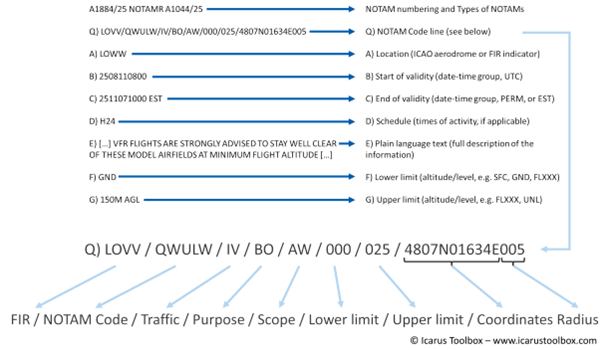
XIV. Fuel
For a complete explanation, read our article: Minimum fuel requirements in NCO
XIV.1 Fuel / Energy Planning Concepts
Contingency fuel/energy = the fuel/energy required to compensate for unforeseen factors that could have an influence on the fuel/energy consumption to the destination aerodrome or vertiport.
Current fuel/energy scheme = the approved fuel/energy scheme that is currently used by the operator.
Safe landing = in the context of the fuel/energy policy or fuel/energy schemes, a landing at an adequate aerodrome or operating site or at an adequate vertiport or diversion location with no less than the final reserve fuel/energy remaining and in compliance with the applicable operational procedures and aerodrome operating minima.
XIV.2 Fuel Emergency And Priority Communications
Minimum fuel = a term used to describe a situation in which an aircraft’s fuel/energy supply has reached a state where the flight is committed to land at a specific aerodrome and no additional delay can be accepted (You are close to using the final reserve).
Controlled flight: transmit “MINIMUM FUEL”.
Any delay may result in landing with less than the planned final reserve — you are committed to land.
Mayday fuel = You are using the final reserve.
Controlled flight: transmit “MAYDAY, MAYDAY, MAYDAY, FUEL”.
The fuel available upon landing at the nearest aerodrome will be less than the final reserve.
XIV.3 Required Fuel On Board
Objective = Onboard fuel/energy and oil are sufficient, considering weather, aircraft performance, expected delays in flight, and contingencies that may reasonably be expected.
XIV.4 Breakdown Of Required Fuel
Taxi fuel = This is the fuel expected to be consumed before take-off (engine start, taxi, delays on ground).
Trip fuel = This is the fuel required from take-off to landing at the destination, including climb, cruise, and descent and procedures. That shall be the amount of fuel that is required to enable the aeroplane to fly from take-off, or from the point of in-flight re-planning, to landing at the destination aerodrome.
Contingency fuel = that shall be the amount of fuel/energy required to compensate for unforeseen factors.
Alternate fuel = If an alternate is needed, plan alternate fuel.
Destination alternate fuel (in CAT) =
(i) when a flight is operated with at least one destination alternate aerodrome, it shall be the amount of fuel required to fly from the destination aerodrome to the destination alternate aerodrome; or
(ii) when a flight is operated with no destination alternate aerodrome, it shall be the amount of fuel required to hold at the destination aerodrome, while enabling the aeroplane to perform a safe landing, and to allow for deviations from the planned operation; as a minimum, this amount shall be 15-minute fuel at holding speed at 1 500ft (450 m) above the aerodrome elevation in standard conditions, calculated according to the estimated aeroplane mass on arrival at the destination aerodrome.
Final reserve fuel in NCO = NCO regulations also impose a final reserve fuel, which must always remain on board at landing (at destination or alternate). It is a protected reserve.
The final reserve fuel should be no less than the required fuel to fly:
-
- VFR day, local flights = 10 minutes at maximum continuous cruise power at 1,500 ft above the aerodrome/landing site, always remaining within sight of it.
- VFR day = 30 minutes at holding speed at 1,500 ft above the destination aerodrome.
- VFR night and IFR = 45 minutes at holding speed at 1,500 ft above the destination or destination alternate aerodrome.
Final reserve fuel in CAT = the amount of fuel that is calculated at holding speed at 1 500ft (450 m) above the aerodrome elevation in standard conditions according to the aeroplane estimated mass on arrival at the destination alternate aerodrome, or destination aerodrome when no destination alternate aerodrome is required, and shall not be less than:
(i) for aeroplanes with reciprocating engines, the fuel to fly for 45 minutes; or
(ii) for turbine-engined aeroplanes, the fuel to fly for 30 minutes.
Additional fuel in CAT = if required by the type of operation; it shall be the amount of fuel to enable the aeroplane to land at a fuel en route alternate aerodrome (fuel ERA aerodrome critical scenario) in the event of an aircraft failure that significantly increases the fuel consumption at the most critical point along the route; this additional fuel is required only if the minimum amount of fuel that is calculated according to points (c)(2) to (c)(5) is not sufficient for such an event.
Extra fuel = to take into account anticipated delays or specific operational constraints.
Discretionary fuel = if required by the commander. The commander’s decision on the amount of fuel to be carried is entirely independent and cannot be encouraged or discouraged. The same principle can apply in NCO: as PIC you are responsible for safety, and nobody should criticise you for carrying extra margin, unless the additional weight makes the aircraft’s performance unsafe.
XV. Weight and Balance
XV.1 General Concepts
‘Mass’ and ‘Weight’ = In accordance with ICAO Annex 5 and the International System of Units (SI), both terms are used to indicate the actual and limiting masses of aircraft, the payload and its constituent elements, the fuel load, etc. These are expressed in units of mass (kg), but in most approved flight manuals and other operational documentation, these quantities are published as weights in accordance with the common language. In the ICAO standardised system of units of measurement, a weight is a force rather than a mass. Since the use of the term ‘weight’ does not cause any problem in the day-today handling of aircraft, its continued use in operational applications and publications is acceptable.
XV.2 Empty And Operating Masses
Basic empty mass (BEM) = the mass of the aircraft including the airframe, engines, permanently installed equipment, unusable fuel, operating fluids and fixed ballast, but excluding crew, usable fuel and traffic load.
Dry operating mass = the total mass of the aircraft ready for a specific type of operation, excluding usable fuel and traffic load.
Dry operating mass (DOM) = the mass of the aircraft ready for a specific type of operation, excluding all usable fuel and traffic load. This mass includes basic empty mass, crew and crew baggage, catering and removable passenger service equipment, potable water and lavatory chemicals.
Operating mass (OM) = the mass of the aircraft including dry operating mass and usable fuel, but excluding traffic load.
XV.3 Payload And Related Masses
Traffic Load (= payload) = The total mass of passengers, baggage, cargo and carry-on specialist equipment and including any ballast. [FL116]
Useful load = the difference between the maximum take-off mass and the dry operating mass, representing the total mass available for traffic load and usable fuel.
Zero fuel mass (ZFM) = the mass of the aircraft including dry operating mass and traffic load, but excluding all usable fuel.
XV.4 Taxi, Take-off And Landing Masses
Taxi mass = the mass of the aircraft at engine start or pushback, including all usable fuel, prior to taxi fuel consumption.
Take-off mass (TOM) = the mass including everything and everyone carried on board at the commencement of the take-off for helicopters or for VCA, and during the take-off run for aeroplanes.
Take-off mass = means the mass including everything and everyone carried at the commencement of the take-off run for aeroplanes. [FL112]
Landing mass (LM) = the mass of the aircraft at touchdown, equal to the take-off mass minus the fuel burned during the flight.
XV.5 Structural Mass Limitations
Maximum Structural Landing Mass = The maximum permissible total aeroplane mass upon landing under normal circumstances. [FL77]
Maximum Structural Take Off Mass = The maximum permissible total airplane mass at the start of the take-off run. [FL78]
Maximum Zero Fuel Mass = The maximum permissible mass of an aeroplane with no usable fuel. The mass of the fuel contained in particular tanks should be included in the zero fuel mass when it is explicitly mentioned in the Aircraft Flight Manual. [FL79]
XVI. Equipment
XVI.1 Recorders And Monitoring Systems
Cockpit voice recorder (CVR) = a crash-protected flight recorder that uses a combination of microphones and other audio and digital inputs to collect and record the aural environment of the flight crew compartment and communications to, from and between the flight crew members.
Flight data recorder (FDR) = a crash-protected flight recorder that uses a combination of data sources to collect and record parameters that reflect the state and performance of the aircraft.
Flight recorder = any type of recorder that is installed on the aircraft for the purpose of facilitating accident or incident safety investigations.
Aircraft tracking system = a system that relies on aircraft tracking in order to identify abnormal flight behaviour and provide alert.
XVI.2 Surveillance, Collision Avoidance And Transponder Systems
Airborne collision avoidance system (ACAS) = an aircraft system based on secondary surveillance radar (SSR) transponder signals which operates independently of ground-based equipment to provide advice to the pilot on potential conflicting aircraft that are equipped with SSR transponders.
Automatic dependent surveillance — broadcast (ADS-B) = a means by which aircraft, aerodrome vehicles and other objects can automatically transmit and/or receive data such as identification, position and additional data, as appropriate, in a broadcast mode via a data link.
Automatic dependent surveillance — contract (ADS-C) = a means by which the terms of an ADS-C agreement will be exchanged between the ground system and the aircraft, via a data link, specifying under what conditions ADS-C reports would be initiated, and what data would be contained in the reports.
Automatic dependent surveillance — contract (ADS-C) agreement = a reporting plan which establishes the conditions of ADS-C data reporting (i.e. data required by the air traffic services unit and frequency of ADS-C reports which have to be agreed to, prior to using ADS-C in the provision of air traffic services).
Mode (SSR) = the conventional identifier related to specific functions of the interrogation signals transmitted by an SSR interrogator. There are four modes specified in ICAO Annex 10: A, C, S and intermode.
Code (SSR) = the number assigned to a particular multiple pulse reply signal transmitted by a transponder in Mode A or Mode C.
Mode S interrogator = a system, composed of antenna and electronics, which supports the addressing of individual aircraft through the Mode Select (Mode S).
Eligible Mode S interrogator = a Mode S interrogator for which at least one of the following conditions is satisfied:
(a) the interrogator relies, at least partly, on Mode S all call interrogations and replies for Mode S targets acquisition.
(b) the interrogator locks out acquired Mode S targets in reply to Mode S all call interrogations, permanently or intermittently, in part or the totality of its coverage. or
(c) the interrogator uses multisite communications protocols for data link applications.
Mode S operator = a person, organisation or enterprise that operates or offers to operate a Mode S interrogator, including:
(a) surveillance service providers.
(b) Mode S interrogator manufacturers.
(c) aerodrome operators.
(d) research establishments.
(e) any other entity entitled to operate a Mode S interrogator.
XVI.3 Electronic Flight Bag (EFB)
Electronic flight bag (EFB) = an electronic information system, comprised of equipment and applications for flight crew, which allows for the storing, updating, displaying and processing of EFB functions to support flight operations or duties.
EFB system = the hardware equipment (including any battery, connectivity provisions, input/output components) and software (including databases and the operating system) needed to support the intended EFB application(s).
EFB host platform = the hardware equipment in which the computing capabilities and basic software reside, including the operating system and the input/output software.
EFB application = a software application installed on an EFB host platform that provides one or more specific operational functions which support flight operations.
Portable EFB = a portable EFB host platform, used on the flight deck, which is not part of the configuration of the certified aircraft.
Type A EFB application = an EFB application whose malfunction or misuse has no safety effect.
Type B EFB application = an EFB application:
(a) whose malfunction or misuse is classified as minor failure condition or below. and
(b) which neither replaces nor duplicates any system or functionality required by airworthiness regulations, airspace requirements, or operational rules.
XVI.4 Vision, Display And Human Interface Systems
Enhanced flight vision system (EFVS)’ is an electronic means to provide the flight crew with a real-time sensor-derived or enhanced display of the external scene topography through the use of imaging sensors. an EFVS is integrated with a flight guidance system and is implemented on a head-up display or an equivalent display system. if an EFVS is certified according to the applicable airworthiness requirements and an operator holds the necessary specific approval (when required), then it may be used for EFVS operations and may allow operations with operational credits.
Enhanced vision system (EVS)’ is an electronic means to provide the flight crew with a real-time image of the actual external scene topography through the use of imaging sensors.
Head-up display landing system (HUDLS) = the total airborne system which provides head-up guidance to the pilot to enable the pilot to either control the aircraft or to monitor the autopilot during take-off (if applicable), approach and landing (and roll-out if applicable), or go-around.
Human–machine interface (HMI) = a component of certain devices that is capable of handling human–machine interactions. The interface consists of hardware and software that allow user inputs to be interpreted and processed by machines or systems that, in turn, provide the required results to the user.
XVI.5 Night Vision Systems
Night vision goggles (NVG) = a head-mounted, binocular, light intensification appliance that enhances the ability to maintain visual surface references at night.
Night vision imaging system (NVIS) = the integration of all elements required to successfully and safely use NVGs while operating a helicopter. The system includes as a minimum: NVGs, NVIS lighting, helicopter components, training and continuing airworthiness.
XVI.6 Hoist, External And Personnel Carrying Equipment
Personnel-carrying device system (PCDS) = a system including one or more devices that is either attached to a hoist or cargo hook or mounted to the rotorcraft airframe during human external cargo (HEC) or helicopter hoist operations (HHO).
Simple personnel carrying device system (simple “PCDS”) = a PCDS that complies with the following conditions:
(a) meets a harmonised standard under Regulation (EU) 2016/425 or Directive 2006/42/EC.
(b) is designed to restrain no more than a single person inside the cabin, or no more than two persons outside the cabin.
(c) is not a rigid structure such as a cage, a platform or a basket.
XVI.7 Communications And Data Link
Data link communications = a form of communication intended for the exchange of messages via a data link.
Controller-pilot data link communications (CPDLC) = a means of communication between controller and pilot, using data link for ATC communications.
XVI.8 Cabin Safety And Emergency Equipment
Emergency exit = an installed exit-type egress point from the aircraft that allows maximum opportunity for cabin and flight crew compartment evacuation within an appropriate time period.
Rectification interval = a limitation on the duration of operations with inoperative equipment.
XVI.9 Portable And Non-installed Equipment
Portable electronic device (PED) = any kind of electronic device, typically but not limited to consumer electronics, brought on board the aircraft by crew members, passengers, or as part of the cargo, that is not included in the configuration of the certified aircraft.
Non-installed equipment = any instrument, equipment, mechanism, apparatus, appurtenance, software or accessory carried on board of an aircraft by the aircraft operator, which is not a part, and which is used or intended to be used in operating or controlling an aircraft, supports the occupants' survivability, or which could impact the safe operation of the aircraft.
Equipment to control unmanned aircraft remotely = any instrument, equipment, mechanism, apparatus, appurtenance, software or accessory that is necessary for the safe operation of an unmanned aircraft, which is not a part, and which is not carried on board of that unmanned aircraft.
XVII. LARGE AEROPLANES (CS-25)
XVII.1 Abbreviations and Acronyms
AC = Advisory Circular
ACAS = Airborne Collision Avoidance System
AFM = Aeroplane Flight Manual
AGL = Above Ground Level
AIM = Airman’s Information Manual
AMC = Acceptable Means of Compliance
ARP = Accepted and Recommended Practice
ATC = Air Traffic Control
ATTCS = Automatic Takeoff Thrust Control System
AWO = All Weather Operations
CDI = Course Deviation Indicator
CG = Centre of Gravity
CL = Lift Coefficient
CLMAX = Maximum Lift Coefficient
CWS = Control Wheel Steering
DA = Decision Altitude
DA(H) = Decision Altitude (Height)
DME = Distance Measuring Equipment
EFIS = Electronic Flight Instrument System
EVS = Enhanced Vision System
FAA = Federal Aviation Administration
FCOM = Flight Crew Operating Manual
F/D = Flight Director
FGS = Flight Guidance System
FLCH = Flight Level Change
FMA = Flight Mode Annunciator
FMS = Flight Management System
GA = Go-around
GLS = GNSS Landing System
GNSS = Global Navigation Satellite System
GPWS = Ground Proximity Warning System
HDD = Head Down Display
HUD = Head-Up Display
IAS = Indicated Air Speed
ICAO = International Civil Aviation Organization
ILS = Instrument Landing System
IMA = Integrated Modular Avionics
IMC = Instrument Meteorological Conditions
ICTS = Ice-Contaminated Tailplane Stall
JAA = Joint Aviation Authorities
LNAV = Lateral Navigation
LOC = Localizer
LWC = Liquid Water Content
MDA(H) = Minimum Descent Altitude (Height)
MED = Mean Effective Diameter
MLS = Microwave Landing System
MSL = Mean Sea Level
MSP = Mode Select Panel
MUH = Minimum Use Height
MVD = Median Volume Diameter
NAV = Navigation
NDB = Non Directional Beacon
ND = Navigation Display
NPA = Notice of Proposed Amendment
NPRM = Notice of Proposed Rulemaking
PF = Pilot Flying
PFD = Primary Flight Display
PNF = Pilot Not Flying
RNAV = Area Navigation
RNP = Required Navigation Performance
RTO = Rejected Takeoff
RVSM = Reduced Vertical Separation Margin
SAE = Society of Automotive Engineering
SVS = Synthetic Vision System
TCAS = Traffic Collision Alert System
TCS = Touch Control Steering
TO = Takeoff
TOGA = Takeoff or Go-around
VMC = Visual Meteorological Conditions
VNAV = Vertical Navigation
VOR = VHF Omni Range
WAT = Weight Altitude Temperature
XVII.2 Manuals and Operational Documentation
Aeroplane Flight Manual (AFM) = An EASA-approved document that contains information, including limitations, operating procedures and performance data, necessary to operate the aeroplane at the level of safety established by its certification basis.
Flight Crew Operating Manual (FCOM) = A document developed by the manufacturer that describes in detail the characteristics and operation of the aeroplane and its systems.
XVII.3 Aerodynamic and Flight Mechanics Concepts
Trim = A flight condition in which the aerodynamic moment acting about the axis of interest is zero. In the absence of an external disturbance, no control input is required to maintain the flight condition.
XVII.4 Electrical and Structural Concepts
Electrical wiring interconnection system (EWIS) = Any wire, wiring device or combination thereof, including termination devices, installed in the aeroplane to transmit electrical energy, data or signals between intended termination points.
Structural performance = The capability of the aeroplane to meet the structural requirements of CS-25.
XVII.5 Operational and Flight Limitations
Flight limitations = Limitations applied to aeroplane flight conditions following an in-flight occurrence and included in the flight manual.
Operational limitations = Limitations applied to aeroplane operating conditions prior to dispatch, including fuel, payload and MMEL-related limitations.
XVII.6 Performance Definitions
Flash point = The lowest temperature at which the application of a flame to a heated sample of a flammable fluid causes its vapour to ignite momentarily.
Screen height = The reference height above the runway surface from which the landing distance is measured, selected between 35 ft and 60 ft, typically 50 ft.
Steep approach landing = An approach to land conducted using a glide path angle greater than or equal to 4.5°.
XVII.7 Display Systems
Head-Up Display (HUD) = A display system that projects primary flight information on a transparent combiner in the pilot’s forward field of view, allowing simultaneous external visual reference and flight information viewing without scanning head-down displays.
XVII.8 Thrust and Takeoff Performance Concepts
Take-off thrust = The approved thrust setting established for take-off operations, presented in the AFM and considered a normal take-off operating limit.
Derated take-off thrust = A take-off thrust less than maximum take-off thrust, for which separate and independent limitations and performance data are provided in the AFM.
Reduced take-off thrust = A take-off thrust less than take-off or derated take-off thrust, established by approved methods, which is not considered a take-off operating limit.
XVIII. BOEING 737NG / 737-800 GENERAL EQUIPMENT AND SYSTEM ABBREVIATIONS
Some abbreviations listed in this section may be used exclusively in simulator environments and may not be applicable to the actual aircraft configuration.
A/P = Autopilot
A/T = Autothrottle
AC = Alternating Current
ACARS = Aircraft Communications Addressing and Reporting System
ACP = Audio Control Panel
ACQ = Acquire
ACT = Active
ADF = Automatic Direction Finder
ADIRU = Air Data Inertial Reference Unit
ADM = Air Data Module
ADS-B = Automatic Dependent Surveillance-Broadcast
AED = Automatic External Defibrillator
AFDS = Autopilot Flight Director System
AFE = Above Field Elevation
AFM = Airplane Flight Manual (FAA approved)
AGL = Above Ground Level
AI = Anti-Ice
AIL = Aileron
ALT = Altitude
ALTN = Alternate
AM = Amplitude Modulation
ANP = Actual Navigation Performance
ANT = Antenna
AOA = Angle of Attack
AOR = Area of Responsibility
APP = Approach
APU = Auxiliary Power Unit
ARINC = Aeronautical Radio, Incorporated
ARPT = Airport
ARTE = Above Runway Threshold Elevation
ATA = Actual Time of Arrival
ATC = Air Traffic Control
ATT = Attitude
AUTO = Automatic
AUX = Auxiliary
AVAIL = Available
B/C or BCRS = Back Course
BARO = Barometric
BAT/BATT = Battery
BRT = Bright
BTL DISCH = Bottle Discharge (fire extinguishers)
BTP = Bromotrifluropropene (fire extinguishers)
C = Captain or Celsius or Center
CANC/RCL = Cancel/Recall
CB = Circuit Breaker
CDFA = Continuous Descent Final Approach
CDU = Control Display Unit
CG = Center of Gravity
CHKL = Checklist
CLB = Climb
COMM = Communication
CON = Continuous
CONFIG = Configuration
CRZ = Cruise
CTL = Control
DA = Decision Altitude
DDA = Derived Decision Altitude
DC = Direct Current
DDG = Dispatch Deviations Guide
DEP ARR = Departure Arrival
DES = Descent
DEU = Display Electronics Unit
DISC = Disconnect
DME = Distance Measuring Equipment
DSPL = Display
E/D = End of Descent
E/E = Electrical and Electronic
EASA = European Aviation Safety Agency
EBAW = Enhanced Bank Angle Warning
ECS = Environmental Control System
EEC = Electronic Engine Control
EFIS = Electronic Flight Instrument System
EGPWS = Enhanced Ground Proximity Warning System
EGT = Exhaust Gas Temperature
ELEC = Electrical
ELEV = Elevator
ENG = Engine
EOSID = Engine Out Standard Instrument Departure
EXEC = Execute
EXT = Extend
F = Fahrenheit
F/D or FLT DIR = Flight Director
F/O = First Officer
FA = Flight Attendant
FAF = Final Approach Fix
FAP = Final Approach Point
FAS = Final Approach Segment
FCC = Flight Control Computer
FCTL = Flight Control
FCTM = Flight Crew Training Manual
FFM = Force Fight Monitor
FL = Flight Level
FMA = Flight Mode Annunciation
FMC = Flight Management Computer
FMS = Flight Management System
FPA = Flight Path Angle
FPV = Flight Path Vector
FSEU = Flap Slat Electronic Unit
G/P = Glide Path
G/S = Glide Slope
GA = Go-Around
GBAS = Ground-Based Augmentation System
GEN = Generator
GLS GBAS = Landing System
GP = Glide Path
GPS = Global Positioning System
GPWS = Ground Proximity Warning System
HDG = Heading
HDG REF = Heading Reference
HDG SEL = Heading Select
HPA = Hectopascals
HUD = Head-Up Display
HYD = Hydraulic
IAN = Integrated Approach Navigation
IAP = Instrument Approach Procedure
IAS = Indicated Airspeed
IAW = In Accordance With
IDENT = Identification
ILS = Instrument Landing System
IMMR = Integrated Multi-Mode Receiver
IN = Inches
INBD = Inboard
IND LTS = Indicator Lights
INOP = Inoperative
INTC CRS = Intercept Course
ISFD = Integrated Standby Flight Display
ISLN = Isolation
K = Knots
KGS = Kilograms
L = Left
LAT = Latitude
LBS = Pounds
LDA = Localizer-type Directional Aid
LDG ALT = Landing Altitude
LE = Leading Edge
LIM = Limit
LNAV = Lateral Navigation
LOM = Locator Outer Marker
LONG = Longitude
LVL CHG = Level Change
MAG = Magnetic
MAN = Manual
MCP = Mode Control Panel
MDA = Minimum Descent Altitude
MEL = Minimum Equipment List
MFD = Multifunction Display
MIN = Minimum
MKR = Marker
MMO = Maximum Mach Operating Speed
MOD = Modify
MTRS = Meters
MVA = Minimum Vectoring Altitude
MX = Maintenance
N1 = Low Pressure Rotor Speed
N2 = High Pressure Rotor Speed
NAV RAD = Navigation Radio
ND = Navigation Display
NDB = Non-Directional Beacon
NGS = Nitrogen Generation System
NM = Nautical Miles
NORM = Normal
NPS = Navigation Performance Scales
OHU = Overhead Unit
OPT = Onboard Performance Tool
OVHD = Overhead
OVRD = Override
PASS = Passenger
PCU = Power Control Unit
PERF INIT = Performance Initialization
PF = Pilot Flying
PFC = Primary Flight Computers
PIC = Pilot In Command
PM = Pilot Monitoring
PNL = Panel
POS = Position
POS INIT = Position Initialization
PRI = Primary
PRW = Perspective Runway
PTU = Power Transfer Unit
PWS = Predictive Windshear System
R = Right
RA = Radio Altitude
RA = Resolution Advisory
RAAS = Runway Awareness and Advisory System
RECIRC = Recirculation
REF = Reference
RET = Retract
RF = Refill
RH = Right Hand
RNP = Required Navigation Performance
RVSM = Reduced Vertical Separation Minimum
S/C = Step Climb
SEL = Select
SMYD = Stall Management Yaw Damper
SPD = Speed
SPLR = Spoiler
STA = Station
STAB = Stabilizer
STAT = Status
STD = Standard
STS = Speed Trim System
T/D = Top of Descent
T or TK or TRK = Track
T or TRU = True
TA = Traffic Advisory
TAI = Thermal Anti-Ice
TAT = Total Air Temperature
TCAS = Traffic Alert and Collision Avoidance System
TDZE = Touch Down Zone Elevation
TE = Trailing Edge
TFC = Traffic
THR HLD = Throttle Hold
TO = Takeoff
TO/GA = Takeoff/Go–Around
UPR DSPL = Upper Display
UTC = Universal Time Coordinated
V/S = Vertical Speed
V1 = Takeoff Decision Speed
V2 = Takeoff Safety Speed
VA = Design Maneuvering Speed
VHF = Very High Frequency
VMO = Maximum Operating Speed
VNAV = Vertical Navigation
VOR VHF = Omnidirectional Range
VR = Rotation Speed
VREF = Reference Speed
VSD = Vertical Situation Display
VTK = Vertical Track
WPT = Waypoint
WXR = Weather Radar
XTK = Cross Track
XIX. Speeds
XIX.1 GENERAL AIRSPEED DEFINITIONS
Indicated Airspeed (IAS) = airspeed shown on the pitot-static airspeed indicator, uncorrected for system errors, and calibrated for standard atmosphere at sea level.
Calibrated Airspeed (CAS) = indicated airspeed corrected for position and instrument error, equal to true airspeed at sea level in standard atmosphere.
Equivalent Airspeed (EAS) = calibrated airspeed corrected for adiabatic compressible flow at a specific altitude, equal to calibrated airspeed at sea level in standard atmosphere.
True Airspeed (TAS) = the airspeed of an aircraft relative to undisturbed air.
Mach Number (MN) = the ratio of true airspeed to the speed of sound.
Ground Speed (GS) = the horizontal speed of an aircraft relative to the Earth’s surface. It is the vector sum of true airspeed (TAS) and wind.
XIX.2 DESIGN AIRSPEEDS
VA = design manoeuvring speed.
Maximum speed at which full and abrupt control deflection will not exceed structural load limits.
VB = design speed for maximum gust intensity.
Turbulence penetration speed protecting the structure from gust loads.
VC = design cruising speed.
Speed for which the aircraft was originally intended to cruise.
VD / MD = design diving speed.
Speed at which the aircraft is designed to dive in smooth air without flutter, control reversal or buffeting.
VDF / MDF = demonstrated flight diving speed.
XIX.3 FLAP SPEEDS
VF = design flap speed.
XIX.4 MINIMUM CONTROL SPEEDS
VMCG = minimum control speed on or near the ground.
Calibrated airspeed during take-off run at which directional control can be maintained using rudder alone (no nosewheel steering), with lateral deviation not exceeding 9.1 m and rudder force not exceeding 667 N.
VMC or VMCA = minimum control speed in the air.
Calibrated airspeed at which control can be maintained with the critical engine inoperative, bank angle not exceeding 5°.
VMCL = minimum control speed during approach and landing with all engines operating.
VMCL-2 = minimum control speed during approach and landing with two engines inoperative (three-engine or more aeroplanes).
XIX.5 STALL SPEEDS
VS = stall speed or minimum steady flight speed at which the aeroplane is controllable.
VSO = stall speed in the landing configuration.
VSR = reference stall speed (CS 25.103).
VSR0 = reference stall speed in landing configuration.
VSR1 = reference stall speed in a specified configuration.
VSW = speed at which stall warning occurs.
VS1 = stall speed in a specified configuration.
VS1g = one-g stall speed.
XIX.6 TAKE-OFF SPEEDS
VEF = calibrated airspeed at which the critical engine is assumed to fail.
VEF may not be less than VMCG.
V1 = take-off decision speed.
Maximum speed at which the pilot must take the first action to stop within accelerate-stop distance.
Also the minimum speed at which, following engine failure at VEF, the take-off can be safely continued.
VR = rotation speed.
Speed at which rotation is initiated to achieve lift-off and reach V2 by 35 ft.
VMU = minimum unstick speed.
Minimum speed at which the aeroplane can safely lift off and continue the take-off.
VLOF = lift-off speed.
Calibrated airspeed at which the aeroplane first becomes airborne.
V2 = take-off safety speed.
Minimum speed to be achieved at 35 ft, providing required climb gradient and manoeuvrability.
V2MIN = minimum take-off safety speed.
Lower limit for V2 based on stall speed and controllability margins.
VFTO = final take-off speed.
Speed at the end of the take-off path, flaps up, one engine inoperative.
VTOSS = VTOL take-off safety speed.
Minimum speed at which climb must be achieved for VCA operated in the Enhanced category.
XIX.7 CLIMB SPEEDS
VX = best angle of climb speed.
Provides maximum climb gradient.
VY = best rate of climb speed.
Provides maximum altitude gain per unit of time.
XIX.8 CRUISE SPEEDS
VMD = minimum drag speed. Best endurance speed.
Best range speed = 1.32 VMD for jet aircraft.
Long range cruise (LRC) = speed providing 99% of maximum range at zero wind.
Drift-down speed = speed providing best drift-down path angle and level-off altitude.
VNE = never exceed speed.
VMO / MMO = maximum operating speed (IAS / Mach).
XIX.9 Reference Speeds (Special Approaches)
VREF(SAL) = The calibrated airspeed selected for a stabilised steep approach landing, maintained down to screen height, not less than 1.23 VSR, VMCL, or the speed required by CS 25.143(h), whichever is greater.
VREF(SAL)-1 = The calibrated airspeed used during a stabilised one-engine-inoperative steep approach landing, not less than VREF(SAL).
XIX.10 LANDING SPEEDS
VLE = maximum landing gear extended speed.
VLO = maximum landing gear operating speed.
VREF = reference landing speed.
VREF ≥ 1.23 VSR0 (CS 25.125).
THRESHOLD SPEEDS AND APPROACH CATEGORIES
VT = threshold speed.
VTmax = maximum threshold speed.
VAT = indicated airspeed at threshold. Used to determine aircraft approach category.
Aircraft categories based on VAT:
- B734 and B738: Category C or D
- B747: Category D
XX. AIRCREW, Training
XX.1 FOUNDATIONS AND CONCEPTS
Competency = a dimension of human performance that is used to reliably predict successful performance on the job and which is manifested and observed through behaviours that mobilise the relevant knowledge, skills and attitudes to carry out activities or tasks under specified conditions.
Competency-based training = assessment and training programmes that are characterised by a performance orientation, emphasis on standards of performance and their measurement and the development of training to the specified performance standards.
Competency framework = a complete set of identified competencies that are developed, trained and assessed in the operators evidence-based training programme utilising scenarios that are relevant to operations and which is wide enough to prepare the pilot for both foreseen and unforeseen threats and errors.
Evidence-based training (EBT) = assessment and training based on operational data that is characterised by developing and assessing the overall capability of a pilot across a range of competencies (competency framework) rather than by measuring the performance in individual events or manoeuvres.
Training to proficiency = training designed to achieve end-state performance objectives, providing sufficient assurance that the trained individual is capable of consistently carrying out specific tasks safely and effectively.
XX.2 EBT PROGRAMME STRUCTURE AND ADMINISTRATION
EBT module = a combination of sessions in a qualified flight simulation training device as part of the 3-year period of recurrent assessment and training.
Enrolment = the administrative action carried out by the operator where a pilot participates in the operator’s EBT programme.
Enrolled pilot = the pilot that participates in the EBT recurrent training programme.
Mixed EBT programme = an operator’s recurrent training and checking programme as per ORO.FC.230, a portion of which is dedicated to the application of EBT but which does not replace proficiency checks as per Appendix 9 to Annex I (Part-FCL) to Regulation (EU) No 1178/2011.
XX.3 TRAINING PHASES AND METHODOLOGY
Evaluation phase = one of the phases of an EBT module which is a line-orientated flight scenario, representative of the operator’s environment during which there are one or more occurrences to evaluate key elements of the defined competency framework.
Manoeuvres training phase = a phase of an EBT module during which, according to aircraft generation, crews have time to practise and improve performance in largely psychomotor skill-based exercises by achieving a prescribed flight path or performing a prescribed event to a prescribed outcome.
Scenario-based training phase = a phase of an EBT module which focuses on the development of competencies, whilst the pilot is trained to mitigate the most critical risks identified for the aircraft generation. It should include the management of specific operator’s threats and errors in a real-time line-orientated environment.
XX.4 EQUIVALENCY CONCEPTS
Equivalency of approaches = all the approaches that place an additional demand on a proficient crew regardless of whether they are used or not in the EBT modules.
Equivalency of malfunctions = all the malfunctions that put a significant demand on a proficient crew regardless of whether they are used or not in the EBT modules.
XX.5 INSTRUCTION AND ASSESSMENT TOOLS
In-seat instruction = a technique used in the manoeuvres training phase or the scenario-based training phase, where the instructors can:
(a) provide simple instructions to one pilot. or
(b) perform predetermined exercises acting, in a pilot seat, as pilot flying (PF) or pilot monitoring (PM) for:
(1) the demonstration of techniques. and/or
(2) triggering the other pilot to intervene or interact.
Instructor concordance = the consistency or stability of scores between different EBT instructors which gives a score (or scores) of how much homogeneity, or consensus, there is in the ratings given by instructors (raters).
Line-orientated flight scenario = the assessment and training involving a realistic, real-time, full mission simulation of scenarios that are representative of line operations.
XX.6 CHECKS AND OPERATIONAL ASSESSMENT
Line check = a check conducted by the operator and completed by the pilot or the technical crew member to demonstrate competence in carrying out normal line operations described in the operations manual.
Operator proficiency check = a check conducted by the operator and completed by the pilot or the technical crew member to demonstrate competence in carrying out normal, abnormal and emergency procedures.
XX.7 SIMULATION AND TRAINING DEVICES
Flight simulation training device = any type of device in which flight conditions are simulated on the ground, including flight simulators, flight training devices, flight and navigation procedures trainers and basic instrument training devices.
Flight simulation training device (FSTD) = a training device which is:
(a) in the case of aeroplanes, a full flight simulator (FFS), a flight training device (FTD), a flight and navigation procedures trainer (FNPT), or a basic instrument training device (BITD).
(b) in the case of helicopters, a full flight simulator (FFS), a flight training device (FTD) or a flight and navigation procedures trainer (FNPT).
XX.8 SYSTEM AND EQUIPMENT TRAINING
System and equipment rating training = training designed to impart specific system/equipment knowledge and skills leading towards operational competence.
XX.9 Licences and Ratings
Airline Transport Pilot Licence (ATPL) = Airline Transport Pilot Licence
Commercial Pilot Licence (CPL) = Commercial Pilot Licence
Instrument Rating (IR) = Instrument Rating
Light Aircraft Pilot Licence (LAPL) = Light Aircraft Pilot Licence
Private Pilot Licence (PPL) = Private Pilot Licence
Basic Instrument Rating (BIR) = Basic Instrument Rating
Multi-Crew Pilot Licence (MPL) = Multi-Crew Pilot Licence
PPL(A) = Private Pilot Licence — Aeroplanes
PPL(H) = Private Pilot Licence — Helicopters
PPL(As) = Private Pilot Licence — Airships
XX.10 Aircraft Categories and Definitions
Complex aeroplane = An aeroplane that meets at least one of the following criteria: a maximum certificated take-off mass exceeding 5 700 kg, a maximum passenger seating configuration of more than nineteen, certification for operation with a minimum crew of two pilots, or equipped with one or more turbojet engines or more than one turboprop engine.
Complex helicopter = A helicopter that meets at least one of the following criteria: a maximum certificated take-off mass exceeding 3 175 kg, a maximum passenger seating configuration of more than nine, or certification for operation with a minimum crew of two pilots.
Rotorcraft = A power-driven, heavier-than-air aircraft that depends principally for its support in flight on the lift generated by up to two rotors.
Vertical take-off and landing (VTOL)-capable aircraft (VCA) = A power-driven, heavier-than-air aircraft, other than an aeroplane or rotorcraft, capable of performing vertical take-off and landing using lift and thrust units.
SEP aeroplane = A single-engine, single-pilot aeroplane for which no type rating is required, operated by a single thrust control and powered by a piston engine, an electric engine system, or a hybrid engine system.
SEP helicopter = A single-engine, single-pilot helicopter powered by a piston engine.
XX.11 Crew Definitions
Cabin crew member = A qualified crew member, other than a flight crew or technical crew member, assigned by an operator to perform duties related to passenger safety and flight operations.
Aircrew = Flight crew and cabin crew.
PIC under supervision (PICUS) = Pilot-in-command under supervision.
XX.12 Licences, Credits and Conversions
Part-FCL licence = A flight crew licence that complies with the requirements of Annex I (Part-FCL).
Non-JAR-compliant licence = A pilot licence issued or recognised by a Member State under national legislation and not recommended for mutual recognition under the relevant JAR.
Credit = The recognition of prior experience or qualifications.
Credit report = A report on the basis of which prior experience or qualifications may be recognised.
Conversion report = A report on the basis of which a licence may be converted into a Part-FCL licence.
Automatically validated = Acceptance without formalities by an ICAO Contracting State of a flight crew licence issued in accordance with ICAO Annex 1.
ICAO attachment = An attachment to an automatically validated flight crew licence issued in accordance with ICAO Annex 1, referenced in item XIII of the licence.
XX.13 Organisations and Training Structures
Approved Training Organisation (ATO) = An organisation approved to provide pilot training in accordance with Article 10a(1).
Declared Training Organisation (DTO) = An organisation entitled to provide pilot training based on a declaration made in accordance with Article 10a(1).
DTO training programme = A document describing in detail the training course provided by a DTO.
Principal place of business = The head office or registered office where the principal financial functions and operational control are exercised.
XX.14 Training Devices and Simulation
Basic Instrument Training Device (BITD) = A ground-based training device representing the student pilot station, used for procedural instrument flight training.
Flight Simulation Training Device (FSTD) = A pilot training device, including full flight simulators, flight training devices, flight and navigation procedures trainers, or BITDs, depending on aircraft category.
FSTD qualification = The level of technical capability of an FSTD as defined in the applicable certification specifications.
Qualification Test Guide (QTG) = A document demonstrating that an FSTD accurately represents the aircraft or aircraft class within prescribed limits.
XXI. Medical
XXI.1 General Medical Definitions
Limitation = A condition placed on a medical certificate or cabin crew medical report that shall be complied with whilst exercising the privileges of the licence or cabin crew attestation.
Aero-medical examination = An inspection, palpation, percussion, auscultation or any other means of investigation for determining the medical fitness to exercise the privileges of the licence or to carry out cabin crew safety duties.
Aero-medical assessment = The conclusion on the medical fitness of an applicant based on the evaluation required under Part-MED and any further examinations or medical tests as clinically indicated.
Significant = A degree of a medical condition, the effect of which would prevent the safe exercise of the privileges of the licence or the performance of cabin crew safety duties.
Applicant = A person applying for, or holding, a medical certificate who undergoes an aero-medical assessment of fitness to exercise the privileges of the licence or to carry out cabin crew safety duties.
Medical history = A narrative or record of past diseases, injuries, treatments or other medical facts, including previous unfit assessments or limitations, that are or may be relevant to an applicant’s current state of health and aero-medical fitness.
Licensing authority = The competent authority of the Member State that issued the licence, or to which a person applies for the issuance of a licence, or, where no licence application has yet been made, the authority determined in accordance with FCL.001.
Colour safe = The ability of an applicant to readily distinguish the colours used in air navigation and to correctly identify aviation coloured lights.
XXI.2 Operations and Medical Context
Helicopter emergency medical services (HEMS) operation = A HEMS flight as defined in point 61 of Annex I to Regulation (EU) No 965/2012.
XXI.3 Medical Evaluation and Risk Assessment
Investigation = The assessment of a suspected pathological condition of an applicant by means of examinations and tests to verify the presence or absence of a medical condition.
Accredited medical conclusion = A conclusion reached by one or more medical experts acceptable to the licensing authority, based on objective and non-discriminatory criteria, and, where appropriate, supported by an operational risk assessment.
XXI.4 Substances and Fitness
Misuse of substances = The use of one or more psychoactive substances by aircrew in a way that constitutes a direct hazard to the user or others, or causes or worsens an occupational, social, mental or physical problem or disorder.
Psychoactive substances = Alcohol, opioids, cannabinoids, sedatives and hypnotics, cocaine, other psychostimulants, hallucinogens and volatile solvents, excluding caffeine and tobacco.
XXI.5 Vision and Optical Definitions
Refractive error = The deviation from emmetropia measured in dioptres in the most ametropic meridian, measured by standard methods.
XXI.6 Medical Certificate Limitation Codes
TML = Limited period of validity of the medical certificate
VDL = Valid only with correction for defective distant vision
VML = Valid only with correction for defective distant, intermediate and near vision
VNL = Valid only with correction for defective near vision
CCL = Correction by means of contact lenses
VCL = Valid by day only
RXO = Specialist ophthalmological examination(s)
SIC = Specific medical examination(s)
HAL = Valid only when hearing aids are worn
APL = Valid only with approved prosthesis
AHL = Valid only with approved hand controls
OML = Valid only as, or with, a qualified co-pilot
OCL = Valid only as a qualified co-pilot
OSL = Valid only with a safety pilot and in aircraft with dual controls
OPL = Valid only without passengers
ORL = Valid only with a safety pilot if passengers are carried
OAL = Restricted to demonstrated aircraft type
SSL = Special restriction(s) as specified
XXI.7 Explanation of Limitation Codes
TML = Time limitation. The validity of the medical certificate is limited to the period shown on the certificate, starting from the date of the medical examination.
VDL = Wear corrective lenses and carry a spare set of spectacles when exercising licence privileges.
VML = Wear multifocal spectacles correcting distant, intermediate and near vision and carry a spare set of spectacles.
VNL = Have corrective spectacles available for near vision and carry a spare set of spectacles.
CCL = Wear approved contact lenses correcting distant vision and carry a spare set of spectacles.
VCL = Valid by day only, applicable to certain holders with colour vision deficiency.
RXO = Specialist ophthalmological examinations are required for a significant medical reason.
SIC = Specific medical examinations are required and the medical assessor of the licensing authority must be contacted prior to revalidation or renewal.
HAL = Wear approved hearing aids while exercising licence privileges and carry spare batteries.
APL = Valid only with an approved prosthesis as demonstrated during medical flight or simulator testing.
AHL = Valid only with approved hand controls installed in the aircraft.
OML = Valid only as, or with, a qualified co-pilot for holders not meeting single-pilot medical requirements.
OCL = Restricted to the role of qualified co-pilot only.
OSL = Valid only with a safety pilot in aircraft with dual controls.
OPL = Valid only without passengers due to increased medical risk.
ORL = Valid only with a safety pilot if passengers are carried and in aircraft with dual controls.
OAL = Restricted to a demonstrated aircraft type due to medical or anatomical limitations.
SSL = Special restriction(s) individually specified to mitigate an increased level of flight safety risk.
XXII. MISCELLANEOUS TERMS
XXII.1 Data, Information and Quality Management
Aeronautical data = a representation of aeronautical facts, concepts or instructions in a formalised manner suitable for communication, interpretation or processing.
Aeronautical database = a collection of aeronautical data organised and arranged as a structured data set, stored electronically on systems, which is valid for a dedicated period and may be updated.
Aeronautical information = information resulting from the assembly, analysis and formatting of aeronautical data.
Aeronautical information product = aeronautical data and aeronautical information provided either as digital data sets or as a standardised presentation in paper or electronic media. Aeronautical information products include:
— aeronautical information publication, including amendments and supplements.
— AIC.
— aeronautical charts.
— NOTAM.
— digital data sets.
Aeronautical information management (AIM) = the dynamic, integrated management of aeronautical information through the provision and exchange of quality-assured digital aeronautical data in collaboration with all parties.
Aeronautical information circular (AIC) = a notice containing information that does not qualify for the origination of a NOTAM or for inclusion in the aeronautical information publication, but which relates to flight safety, air navigation, technical, administrative or legislative matters.
Aeronautical information publication (AIP) = a publication issued by or with the authority of a State and containing aeronautical information of a lasting character essential to air navigation.
AIP amendment = a permanent change to the information contained in the AIP.
AIP supplement = a temporary change to the information contained in the AIP, which is provided by means of special pages.
Aeronautical information regulation and control (AIRAC) = a system aimed at advance notification, based on common effective dates, of circumstances that necessitate significant changes in operating practices.
Authoritative source =:
(a) a State authority: or
(b) an organisation formally recognised by the State authority to originate and/or publish data which meets the data quality requirements (DQRs) as specified by that State.
Assemble = a process of merging data from multiple sources into a database and establishing a baseline for subsequent processing.
Completeness = in relation to data, the degree of confidence that all data needed to support the intended use is provided.
Confidence level = the probability that the true value of a parameter is within a certain interval around the estimate of its value.
Data accuracy = a degree of conformance between the estimated or measured value and the true value.
Data integrity = a degree of assurance that aeronautical data and its value has not been lost or altered since the data origination or authorised amendment.
Data item = a single attribute of a complete data set, which is allocated a value that defines its current status.
Data origination = the creation of a new data item with its associated value, the modification of the value of an existing data item or the deletion of an existing data item.
Data product specification = a detailed description of a data set or a collection of data sets together with additional information that will enable it to be created, supplied to and used by another party.
Data quality = a degree or level of confidence that the provided data meets the user's data requirements in terms of accuracy, resolution, integrity (or equivalent assurance level), traceability, timeliness, completeness, and format.
Data quality requirements (DQRs) = a specification of the characteristics of data (i.e. accuracy, resolution, integrity (or equivalent assurance level), traceability, timeliness, completeness and format) to ensure that the data is compatible with its intended use.
Data set = an identifiable collection of data.
Format = in relation to data, a structure of data items, records and files arranged to meet standards, specifications or data quality requirements.
Integrity classification = in relation to aeronautical data, a classification based upon the potential risk resulting from the use of corrupted data, defining routine, essential and critical data.
Metadata = data about data.
Resolution = in relation to data, a number of units or digits to which a measured or calculated value is expressed and used.
Timeliness = in relation to data, the degree of confidence that the data is applicable to the period of its intended use.
Traceability = in relation to data, the degree to which a system or a data product can provide a record of the changes made to that product and thereby enable an audit trail to be followed from the end-user to the party originating data.
Validation = in relation to data, the process of ensuring that data meets the requirements for the specified application or intended use.
Verification = in relation to data, the evaluation of the output of an aeronautical data process to ensure correctness and consistency with respect to the inputs and applicable data standards, rules and conventions used in that process.
Tailored data = aeronautical data which is provided by the aircraft operator or DAT provider on the aircraft operator's behalf and produced for this aircraft operator for its intended operational use.
XXII.2 Meteorology and Weather Services
Aerodrome climatological summary = a concise summary of specified meteorological elements at an aerodrome, based on statistical data.
Aerodrome climatological table = a table providing statistical data on the observed occurrence of one or more meteorological elements at an aerodrome.
Aerodrome warning = information issued by an aerodrome meteorological office concerning the occurrence or expected occurrence of meteorological conditions which could adversely affect aircraft on the ground, including parked aircraft and the aerodrome facilities and services.
Aeronautical meteorological station = a station making observations and meteorological reports for use in air navigation.
Area forecast for low-level flights = a forecast of weather phenomena for a flight information region or sub-area thereof, issued to cover the layer below flight level 100 (or below flight level 150 in mountainous areas, or higher, where necessary).
Automatic observing system = an observing system that measures, derives and reports all required elements without human interaction.
Semi-automatic observing system = an observing system that allows the augmentation of measured elements and requires a human in the loop for issuing the appropriate reports.
Grid point data in digital form = computer-processed meteorological data for a set of regularly spaced points on a chart, for transmission from a meteorological computer to another computer in a code form suitable for automated use.
Gridded global forecasts = forecasts of expected values of meteorological elements on a global grid with a defined vertical and horizontal resolution.
XXII.3 Airspace, ATS Units and Control
Air traffic services unit = a generic term meaning variously air traffic control unit, flight information centre, aerodrome flight information service unit or air traffic services reporting office.
Area control centre (ACC) = a unit established to provide air traffic control service to controlled flights in control areas under its jurisdiction.
Boundary = a lateral or vertical plane delineating the airspace in which an ATC unit provides air traffic services.
Control zone = a controlled airspace extending upwards from the surface of the Earth to a specified upper limit.
Controlled aerodrome = an aerodrome at which air traffic control service is provided to aerodrome traffic.
Controlled airspace = an airspace of defined dimensions within which air traffic control service is provided in accordance with the airspace classification.
Controlled flight = any flight which is subject to an ATC clearance.
Clearance limit = the point to which an aircraft is granted an ATC clearance.
Critical area = an area of defined dimensions extending around the ground equipment of a precision instrument approach within which the presence of vehicles or aircraft will cause unacceptable disturbance of the guidance signals.
Runway-in-use = the runway or runways that, at a particular time, are considered by the air traffic services unit to be the most suitable for use by the types of aircraft expected to land or take off at the aerodrome. Separate or multiple runways may be designated runway-in-use for arriving aircraft and departing aircraft.
Near-parallel runways = non-intersecting runways whose extended centre lines have an angle of convergence/divergence of 15 degrees or less.
XXII.4 Duty, Work Organisation and Human Resources
Duty = any task that an air traffic controller is required to perform by the air traffic control service provider.
Duty period = a period which starts when an air traffic controller is required by the air traffic control service provider to report for or be available for or to commence duty and ends when the air traffic controller is free from duty.
Rest period = a continuous and defined period of time, subsequent to and/or prior to duty, during which an air traffic controller is free of all duties.
Break = a period of time within the duty period when an air traffic controller is not required to perform duties, for recuperation purposes.
Rostering system = the structure of duty and rest periods of air traffic controllers in accordance with legal and operational requirements.
Working position = the furniture and technical equipment at which a member of the air traffic services staff undertakes task associated with their job.
XXII.5 Navigation, Procedures and Operations
Cruise climb = an aeroplane cruising technique resulting in a net increase in altitude as the aeroplane mass decreases.
Cruising level = a level maintained during a significant portion of a flight.
Flight procedure = a set of predetermined flight manoeuvres intended to be followed by a pilot, published by electronic, printed or digital means, or both. Flight procedure is conducted either in accordance with instrument flight rules (IFR) or visual flight rules (VFR).
Flight procedure designer = a qualified person who performs design, documentation, validation, continuous maintenance, and periodic review of flight procedures.
Flight procedure design services = services for the design, documentation, validation, maintenance and periodic review of flight procedures necessary for the safety, regularity and efficiency of air navigation.
Glide path = a descent profile determined for vertical guidance during a final approach.
Navigation aid = a facility or system external to the aircraft, which generates electro-magnetic signals to be used by aircraft navigation systems for position determination or flight path guidance.
Conventional navigation route = an ATS route established by reference to ground navigation aids.
Area navigation (RNAV) = a method of navigation which permits aircraft operation on any desired flight path within the coverage of ground- or space-based navigation aids or within the limits of the capability of self-contained aids, or a combination of them.
XXII.6 Technical Systems and Equipment
Functional system = a combination of procedures, human resources and equipment, including hardware and software, organised to perform a function within the context of ATM/ANS and other ATM network functions.
ATM/ANS equipment = ATM/ANS constituents as defined in Article 3(6) of Regulation (EU) 2018/1139, and ATM/ANS systems as defined in Article 3(7) of that Regulation, excluding airborne constituents, which are subject to Commission Regulation (EU) No 748/2012 ( 2 ).
Certified aircraft application = a software application approved by the Agency as part of aircraft subject to Article 4 of Regulation (EC) No 216/2008.
Harmful interference = interference that prevents the performance requirements from being achieved.
Eligible interrogator code = any code among the II codes and the SI codes, except:
(a) II code 0.
(b) the interrogator code(s) reserved for military entities, including intergovernmental organisations and in particular North Atlantic Treaty Organisation management and allocation.
Interrogator code allocation plan = the most recently approved complete set of interrogator code allocations.
Implementation sequence = the time-bounded sequence of implementation of interrogator code allocations with which Mode S operators need to comply to avoid temporary interrogator code conflicts.
XXII.7 Alerts, Warnings and Coordination
Warning = a message displayed at a working position when the automated coordination process has failed.
Coordination data = data of interest to operational staff in connection with the process of notification, coordination and transfer of flights, and with the process of civil-military coordination.
Coordination point (COP) = a point on or adjacent to the boundary used by the ATC units and referred to in coordination processes.
Estimate data = the coordination point, the estimated time of an aircraft and the expected flight level of the aircraft at the coordination point.
Notified unit = the ATC unit that has received the notification information.
Transfer of control point = a defined point located along the flight path of an aircraft, at which the responsibility for providing air traffic control service to the aircraft is transferred from one control unit or control position to the next.
XXII.8 Miscellaneous Technical Definitions
Argument = a claim that is supported via inferences by a body of evidence.
Datum = any quantity or set of quantities that may serve as a reference or basis for the calculation of other quantities.
Feature = an abstraction of real world phenomena.
Feature attribute = a characteristic of a feature that has a name, a data type and a value domain associated with it.
Feature type = a class of real world phenomena with common properties, which forms the basic level of classification in a feature catalogue.
Position = in a geographical context, a set of coordinates (latitude and longitude) referenced to the mathematical reference ellipsoid, which define the position of a point on the surface of the Earth.
Identification = the situation which exists when the position indication of a particular aircraft is seen on a situation display and positively identified.
Situation display = an electronic display depicting the position and movement of aircraft and other information as required.
Traffic information = information issued by an air traffic services unit to alert a pilot to other known or observed air traffic which may be in proximity to the position or intended route of flight and to help the pilot avoid a collision.
XXIII. References
Air Operations (Regulation (EU) No 965/2012)
EUR-Lex: www.eur-lex.europa.eu
Document 02012R0965 — EN — 01.05.2025 — 030.002
Standardised European Rules of the Air (Regulation (EU) No 923/2012)
EUR-Lex: www.eur-lex.europa.eu
Document 02012R0923 — EN — 01.05.2025 — 012.001
Air Traffic Management/Air Navigation Services (ATM-ANS) — Provision of Services (Regulation (EU) 2017/373)
EUR-Lex: www.eur-lex.europa.eu
Document 02017R0373 — EN — 01.05.2025 — 010.001
Basic Regulation (Regulation (EU) 2018/1139)
EUR-Lex: www.eur-lex.europa.eu
Document 02018R1139 — EN — 25.05.2025 — 003.001
Aircrew (Regulation (EU) No 1178/2011)
EUR-Lex: www.eur-lex.europa.eu
Document 02011R1178 — EN — 04.08.2025 — 024.001
Certification Specifications and Acceptable Means of Compliance for Large Aeroplanes (CS-25)
Please consult the official websites for the most up-to-date information.